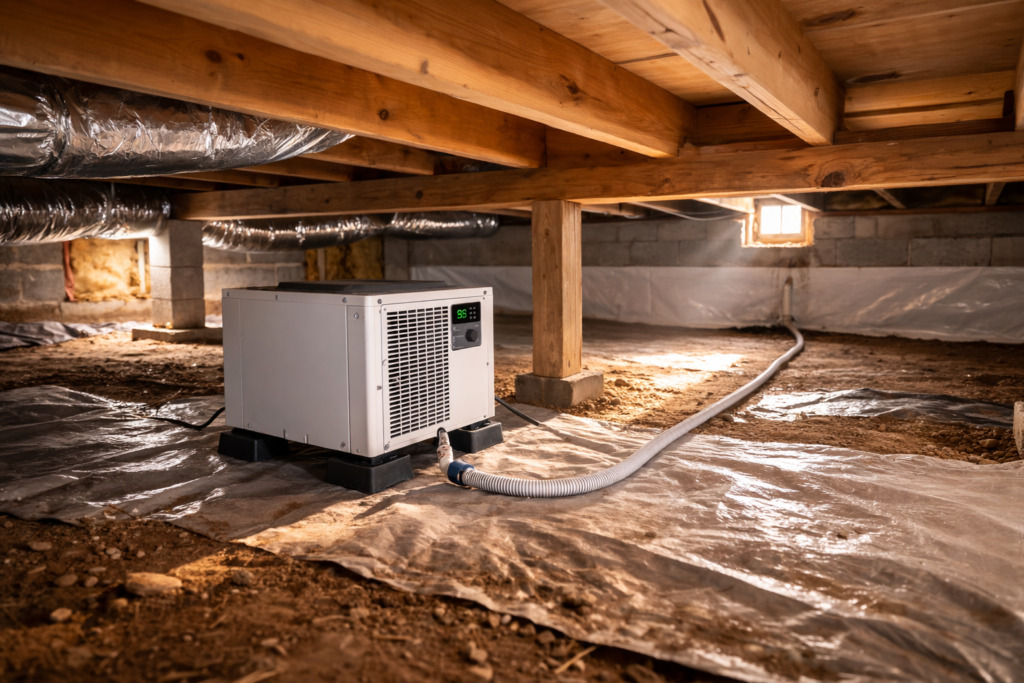
For most small crawl spaces, the best crawl space dehumidifier is a compact crawlspace-focused unit with reliable drainage, enough capacity for the moisture level, and enough clearance for airflow and filter access. A small crawl space does not always need the largest commercial-style unit, but it still needs equipment designed for damp, low-clearance, hard-to-access areas.
The BaseAire Crawlspace Dehumidifier with Pump is the strongest starting point for most small crawl spaces because it gives buyers a compact crawlspace option with pump drainage support. The BaseAire AirWerx 35P 70-Pint Crawlspace Dehumidifier with Pump is a better fit when drainage is awkward, while the E070 Pro Dehumidifier Bundle makes more sense for a sealed or encapsulated small crawl space where a more complete setup is needed.
Quick Picks
- Best overall for most small crawl spaces: BaseAire Crawlspace Dehumidifier with Pump
- Best for awkward drainage: BaseAire AirWerx 35P 70-Pint Crawlspace Dehumidifier with Pump
- Best complete kit option: E070 Pro Dehumidifier Bundle – 70 Pint Whole House Dehumidifier – Full Complete Kit – Crawl Spaces
If the crawl space is small but regularly damp, do not choose only by square footage. A small vented crawl space with heavy moisture can need more dehumidification than a larger sealed crawl space with only mild humidity.
The best choice depends on the actual conditions under the house, including clearance, drainage route, humidity level, sealing, and how easy the unit will be to service later.
What Counts as a Small Crawl Space?
A small crawl space is not only about floor area. It is also about height, access, airflow, drainage, and how easily the dehumidifier can be installed and maintained.
For buying purposes, a small crawl space usually means the unit needs to fit through a limited access opening, sit low enough under the floor framing, and leave enough room around the cabinet for airflow. A compact unit can still be the wrong choice if the filter, controls, drain hose, or pump line are difficult to reach after installation.
Small crawl spaces can also behave very differently depending on whether they are sealed or vented. A sealed crawl space may be easier to control because humid outdoor air is reduced. A vented crawl space may need more help because damp outside air can keep entering the space.
That is why the best small crawl space dehumidifier is not always the smallest unit. The better goal is to choose a crawlspace-rated unit that fits physically, drains reliably, and has enough capacity for the actual moisture load.
BaseAire Crawlspace Dehumidifier with Pump

A compact pump-equipped crawlspace option for smaller areas where drainage and access both matter.
The BaseAire Crawlspace Dehumidifier with Pump is the best overall choice on this page because it matches the main small crawl space buyer intent. It is positioned as a crawlspace-focused option with pump support, which makes it a practical starting point for tight areas where drainage cannot be ignored.
Best for: Small crawl spaces where the buyer wants a compact crawlspace dehumidifier with pump drainage support.
Why it fits small crawl spaces: It gives buyers a crawlspace-specific option without immediately moving to a larger commercial-style unit. That matters when the space is tight, access is limited, and the buyer wants a practical humidity-control setup rather than the biggest machine available.
Main limitation: It may not be the best fit for a large, very wet, or repeatedly damp crawl space where a higher-capacity unit would be more appropriate.
Choose this if: You want a sensible first-choice unit for a smaller crawl space and pump drainage would make the installation easier.
Skip this if: Your crawl space has severe moisture problems, standing water, major air leaks, or a size/moisture load that clearly calls for a larger setup.
BaseAire AirWerx 35P 70-Pint Crawlspace Dehumidifier with Pump
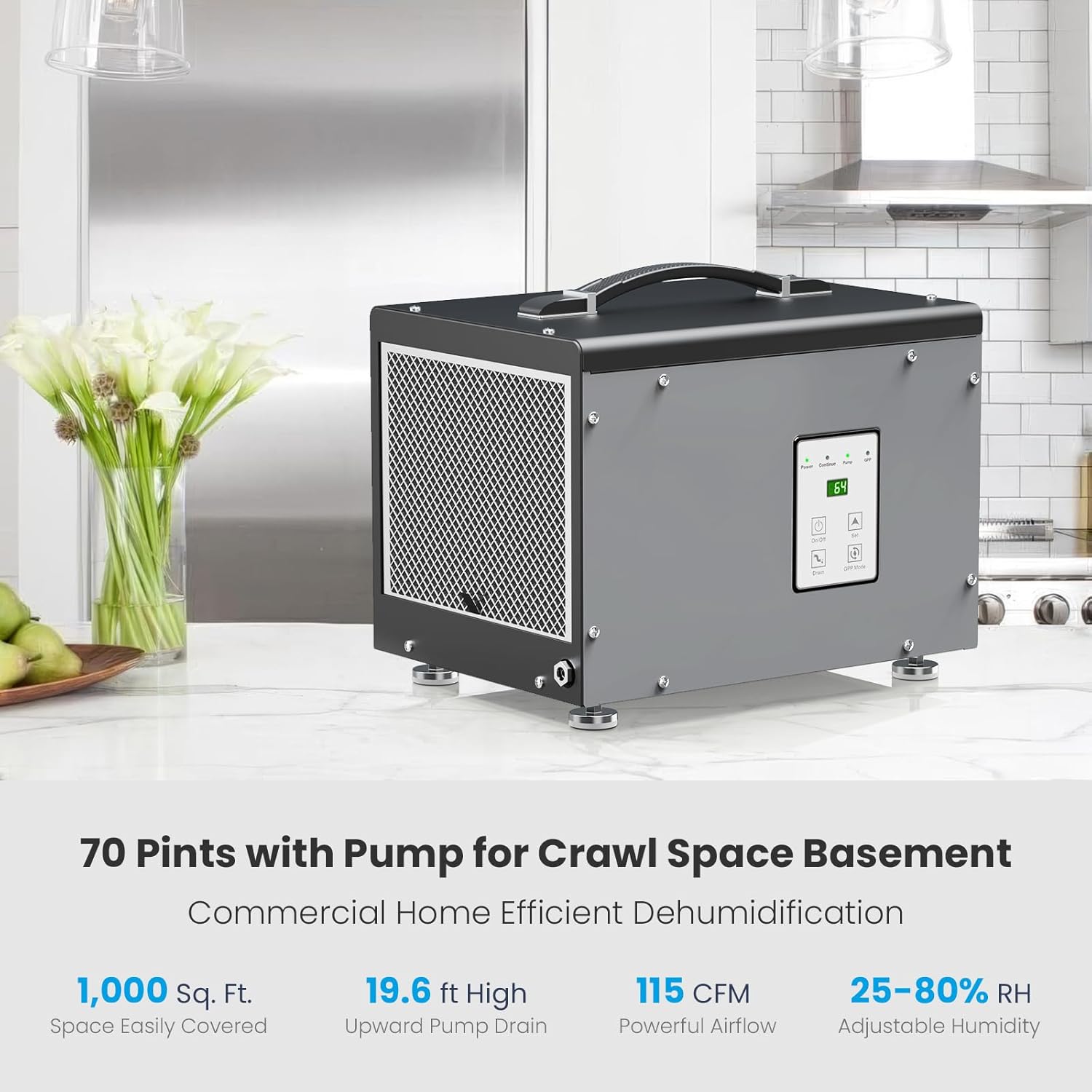
A pump-equipped crawl space dehumidifier for small areas where gravity drainage is not convenient.
The BaseAire AirWerx 35P 70-Pint Crawlspace Dehumidifier with Pump is the better choice when the crawl space is small but the drainage route is awkward. Small spaces are not always easy spaces. A tight crawl space can still have a poor drain path, limited slope, or no convenient low discharge point.
Best for: Small crawl spaces where the dehumidifier needs to pump water away instead of relying on a simple gravity drain.
Why it fits small crawl spaces: The pump-focused setup gives the buyer more flexibility when planning where the collected water will go. This can be useful when the drain hose needs to travel to a more practical discharge location.
Main limitation: A pump does not remove the need for proper planning. The hose still needs a safe discharge route, and the unit still needs to be positioned where it can move air and be serviced.
Choose this if: Drainage is the main challenge in your small crawl space and you do not have an easy gravity drain option.
Skip this if: Your crawl space already has a simple gravity drain path and you want the simplest possible setup.
E070 Pro Dehumidifier Bundle – 70 Pint Whole House Dehumidifier – Full Complete Kit – Crawl Spaces
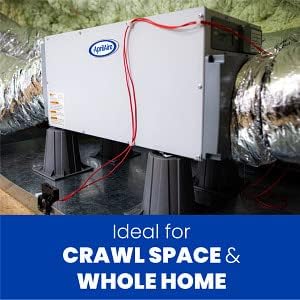
A crawl space and whole-house dehumidifier bundle for sealed small crawl spaces needing a more complete setup.
The E070 Pro Dehumidifier Bundle is the stronger alternative when the small crawl space is sealed, encapsulated, or already improved with basic moisture-control work. It makes the most sense when the buyer wants a planned crawl space humidity-control setup rather than the smallest possible unit.
Best for: Small sealed or encapsulated crawl spaces where a complete kit is more useful than a basic compact option.
Why it fits small crawl spaces: A sealed crawl space often benefits from a more controlled setup. If the space has already been encapsulated or improved, a complete kit-style option can suit buyers who want a cleaner long-term installation.
Main limitation: It may be more than a very small, mildly humid crawl space needs. Buyers should check the actual space size, moisture level, clearance, and installation requirements before choosing it.
Choose this if: Your small crawl space is sealed or encapsulated and you want a more complete humidity-control setup.
Skip this if: You only need a simple compact unit for a lightly damp crawl space with straightforward drainage.
What Size Dehumidifier Is Best for a Small Crawl Space?
The best size dehumidifier for a small crawl space depends on more than the square footage. A small, sealed crawl space with mild humidity may not need the same capacity as a small vented crawl space that keeps taking in damp outside air.
Moisture level, sealing, drainage, air movement, and access all matter. If the crawl space is damp every season, has visible condensation, or sits under a humid part of the home, choosing a slightly stronger crawlspace-rated unit can make more sense than choosing the smallest model available.
At the same time, oversizing is not automatically better. A larger unit can cost more, take up more space, and be harder to position in a tight crawl space. The best option is the smallest suitable crawlspace-rated unit that can maintain steady humidity while still allowing proper airflow and service access.
For a fuller sizing breakdown, see What Size Dehumidifier Do I Need for a Crawl Space?.
Do Small Crawl Spaces Need a Dehumidifier With a Pump?
A small crawl space does not always need a dehumidifier with a pump, but a pump-equipped unit can be useful when gravity drainage is difficult. If the water cannot drain downward to a suitable location, a pump can make the installation more flexible.
Gravity drainage is usually simpler when the unit can drain continuously downhill through a hose. The problem is that many small crawl spaces do not have a convenient drain route. The discharge point may be too far away, the ground may not slope correctly, or the unit may need to send water to a location that is not lower than the dehumidifier.
In those situations, a pump model can be the better choice. The buyer still needs to plan the hose route carefully, but a pump can make the installation more practical in a tight space.
For more help with this decision, see Best Crawl Space Dehumidifier with Pump, Do Crawl Space Dehumidifiers Need a Drain Line?, and Gravity Drain vs Pump Drain for Crawl Space Dehumidifiers.
Can You Use a Regular Dehumidifier in a Small Crawl Space?
A regular room dehumidifier may work temporarily in some mild situations, but it is usually not the best permanent choice for a crawl space. Crawl spaces are harder to access, often need continuous drainage, and may have lower clearance than a normal room.
A room dehumidifier can also be inconvenient if the bucket needs to be emptied manually. In a crawl space, that usually becomes frustrating quickly. A crawlspace-focused unit is normally a better fit because it is designed around continuous drainage, harder installation conditions, and longer-term humidity control.
This is especially important if the crawl space is damp most of the year, has musty odors, supports mold growth, or affects indoor comfort above the floor. In those cases, the goal is not just to remove a little moisture. The goal is to keep the crawl space stable over time.
For a deeper explanation, see Can You Put a Regular Dehumidifier in a Crawl Space?.
What to Check Before Buying
- Clearance: Make sure the dehumidifier can physically fit through the access opening and sit in the crawl space with enough room around it.
- Airflow: Do not place the unit where joists, stored items, walls, or insulation block air movement.
- Drainage: Decide early whether gravity drainage will work or whether a pump model is easier.
- Service access: You still need to reach the filter, drain hose, controls, and pump area after installation.
- Moisture level: A small crawl space with heavy moisture may need more capacity than a small crawl space with only mild humidity.
- Sealed vs vented: A sealed crawl space is often easier to control than a vented crawl space that keeps taking in damp outdoor air.
The biggest mistake is buying only by the word “small.” A crawl space can be small but still difficult if it is wet, poorly drained, vented, or hard to access. The better choice is the unit that fits the physical space and matches the actual moisture problem.
Where Should a Dehumidifier Go in a Small Crawl Space?
In a small crawl space, the dehumidifier should be placed where it can move air across the space, drain properly, and be reached for maintenance. The best location is not always the exact center of the crawl space if that area makes drainage or service access difficult.
Try to avoid tight corners, blocked airflow, and locations where the filter or drain hose will be hard to reach later. A compact crawl space can make installation feel like a puzzle, but the unit still needs room to breathe.
If the crawl space has separate sections, foundation walls, narrow passages, or areas that stay wetter than others, placement becomes more important. In some cases, ducting, air movement, or professional installation may be needed to control the whole space evenly.
For more detail, see Where Should You Place a Dehumidifier in a Crawl Space?.
Frequently Asked Questions
What size dehumidifier do I need for a small crawl space?
A small crawl space usually needs a compact crawlspace-rated dehumidifier with enough capacity for the actual moisture level. Do not choose by square footage alone. A sealed, mildly damp crawl space may need less capacity than a small vented crawl space with ongoing moisture.
Is a 70-pint dehumidifier too big for a small crawl space?
Not always. A 70-pint class crawlspace dehumidifier may still make sense if the crawl space is damp, vented, or difficult to control. It may be more than necessary for a very small, sealed crawl space with only mild humidity, so buyers should check the conditions before choosing.
Does a small crawl space dehumidifier need a pump?
A pump is useful when gravity drainage is not practical. If the drain hose can run continuously downhill to a safe discharge point, gravity drainage may be enough. If the water needs to move upward or across an awkward route, a pump-equipped unit can be easier to install.
Can I use a normal room dehumidifier in a small crawl space?
A normal room dehumidifier may help temporarily in mild conditions, but it is usually not the best permanent solution. Crawl spaces often need continuous drainage, low-clearance placement, and equipment that can operate reliably in a harder-to-access area.
Should a small crawl space dehumidifier run all the time?
It may run often when the crawl space is damp, but it should cycle based on humidity once conditions are under control. If it runs constantly without improving humidity, the space may have air leaks, drainage issues, standing water, or a unit that is not matched to the moisture load.
Final Recommendation
For most small crawl spaces, the BaseAire Crawlspace Dehumidifier with Pump is the best overall choice because it gives buyers a compact crawlspace-focused option with pump drainage support. It is the strongest starting point when the buyer wants a practical unit for a smaller area without jumping straight to a large commercial-style setup.
The BaseAire AirWerx 35P 70-Pint Crawlspace Dehumidifier with Pump is the better choice when drainage is the main challenge. A small crawl space can still be difficult to drain, and a pump-equipped model gives the buyer more flexibility when gravity drainage is not convenient.
The E070 Pro Dehumidifier Bundle – 70 Pint Whole House Dehumidifier – Full Complete Kit – Crawl Spaces is the better fit for small sealed or encapsulated crawl spaces where a more complete setup matters more than choosing the smallest possible unit.
The main thing to avoid is choosing only by size. A small crawl space still needs the right drainage setup, enough airflow, and enough capacity for the actual moisture problem. Choose the unit that fits the space, can be serviced later, and matches how damp the crawl space really is.