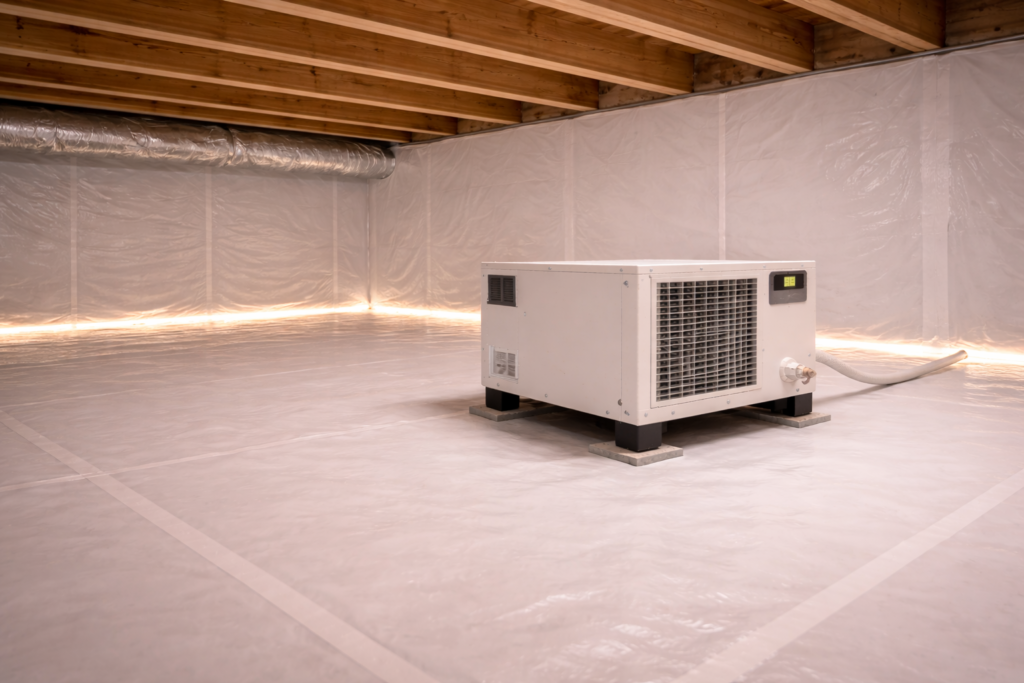
An encapsulated crawl space is sealed with a vapor barrier on the floor and walls to reduce outside moisture intrusion. While encapsulation helps stabilize humidity, most sealed crawl spaces still require a properly sized dehumidifier for consistent moisture control.
The best dehumidifier for an encapsulated crawl space is one that maintains steady humidity without running constantly.
Why Encapsulated Spaces Still Need Dehumidifiers
Sealing reduces moisture entry, but humidity can still come from:
-
Residual ground moisture
-
Minor air leaks
-
Plumbing penetrations
-
Seasonal humidity changes
Encapsulation creates a controlled environment — but that environment still requires active moisture management.
If you are unsure whether your sealed space needs one, see Do You Need a Dehumidifier in a Sealed Crawl Space?
Proper Sizing Is Essential
Encapsulated crawl spaces often require slightly lower capacity than vented spaces of the same size, but sizing still depends on square footage and moisture levels.
For proper sizing guidance, review:
Correct capacity prevents short cycling and improves efficiency.
Features to Look For
For encapsulated crawl spaces, prioritize:
-
Adjustable humidistat
-
Stable low-speed operation
-
Continuous drainage capability
-
Low-temperature performance
-
Energy-efficient compressor
Encapsulated environments benefit from consistent, balanced humidity control rather than aggressive moisture removal.
For full selection guidance, read How to Choose a Crawl Space Dehumidifier.
Drainage Setup
Even in sealed crawl spaces, continuous drainage is required.
Most systems use:
-
Gravity drain to a sump pit
-
Built-in pump if upward discharge is necessary
If drainage flexibility is needed, compare options in Best Crawl Space Dehumidifier with Pump.
Ideal Humidity Target
Encapsulated crawl spaces should typically maintain:
45%–55% relative humidity
Once balanced, a properly sized unit should cycle periodically rather than run nonstop.
Energy Efficiency Considerations
Because sealed crawl spaces are more controlled environments, they often operate efficiently once stabilized.
If operating cost is a priority, see Best Energy Efficient Crawl Space Dehumidifier.
Reducing air leaks and ensuring proper vapor barrier installation also improves long-term efficiency.
Final Thoughts
The best dehumidifier for an encapsulated crawl space:
-
Matches the square footage
-
Maintains steady humidity
-
Supports continuous drainage
-
Operates efficiently year-round
Encapsulation reduces moisture load, but active humidity control is still the key to protecting the structure above.