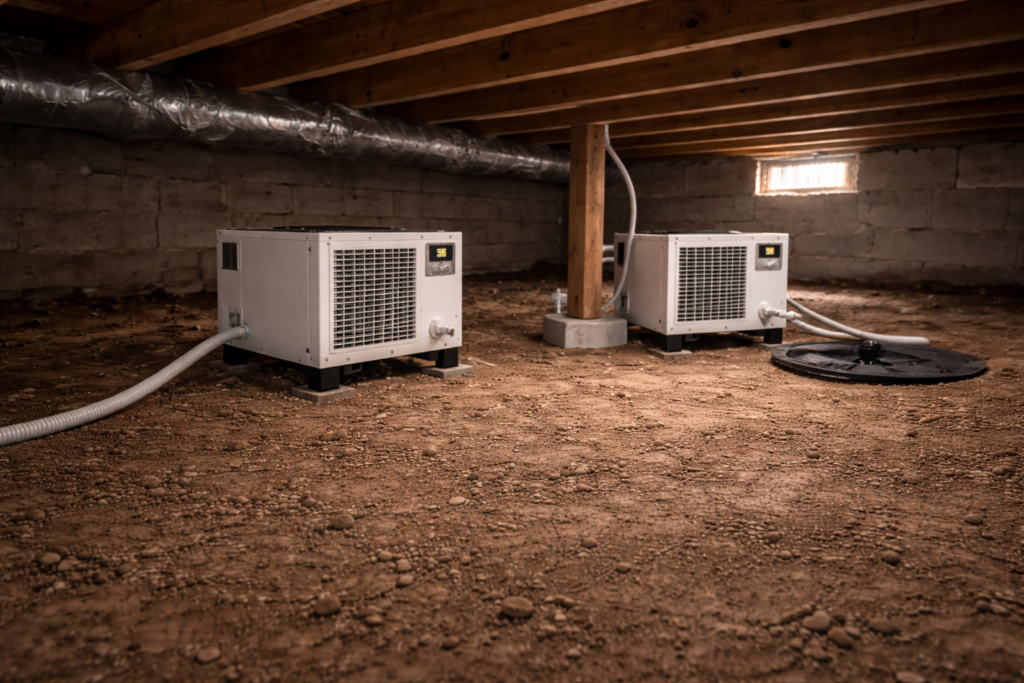
Crawl space dehumidifiers are designed for continuous operation, which means they must discharge collected water automatically. There are two main drainage methods used in crawl spaces:
-
Gravity drain
-
Built-in condensate pump
The right choice depends on your crawl space layout and drain access.
How Gravity Drain Works
Gravity drainage relies on natural downward flow.
Water exits the dehumidifier through a hose that slopes downward into:
-
A sump pit
-
A floor drain
-
An exterior discharge point
For gravity drainage to work properly:
-
The hose must maintain a consistent downward slope
-
There must be no kinks or upward bends
-
The drain point must sit lower than the unit
Gravity systems are simple and require fewer mechanical components.
If you are unsure about placement requirements, see Where Should You Place a Dehumidifier in a Crawl Space?
How a Pump Drain Works
A built-in condensate pump allows water to be discharged:
-
Upward
-
Across longer horizontal distances
-
To a higher drain location
The pump automatically activates when water reaches a certain level inside the unit.
Pump systems are useful when:
-
There is no lower drain point
-
The sump pit is located above the dehumidifier
-
The discharge line must travel a longer distance
For general drainage requirements, review Do Crawl Space Dehumidifiers Need a Drain Line?
Advantages of Gravity Drain
-
Fewer moving parts
-
Lower mechanical complexity
-
No pump noise
-
Reduced long-term maintenance
If your crawl space layout allows for natural downward drainage, gravity systems are often the simplest solution.
Advantages of Pump Drain
-
Flexible placement options
-
Works when no gravity drain exists
-
Can discharge water to higher locations
Pump-equipped units provide more installation flexibility in complex layouts.
Sizing and Drainage Go Together
Higher-capacity units remove more water, which increases the importance of reliable drainage.
If you are still determining the correct unit size, see:
Proper sizing combined with proper drainage ensures stable humidity control.
Which Is Better?
Neither system is universally better.
Choose gravity drainage if:
-
You have a lower drain point
-
You want a simpler setup
-
You prefer fewer mechanical components
Choose a pump system if:
-
The drain location is higher
-
The hose must travel upward
-
Your crawl space layout is restrictive
The best choice depends entirely on your specific crawl space configuration.
Final Thoughts
Both gravity and pump drainage systems are effective when installed correctly.
The key is ensuring:
-
Secure hose connections
-
Unobstructed water flow
-
Reliable discharge point
Once drainage is properly configured, your crawl space dehumidifier can operate continuously and maintain stable humidity levels between 45% and 55%.