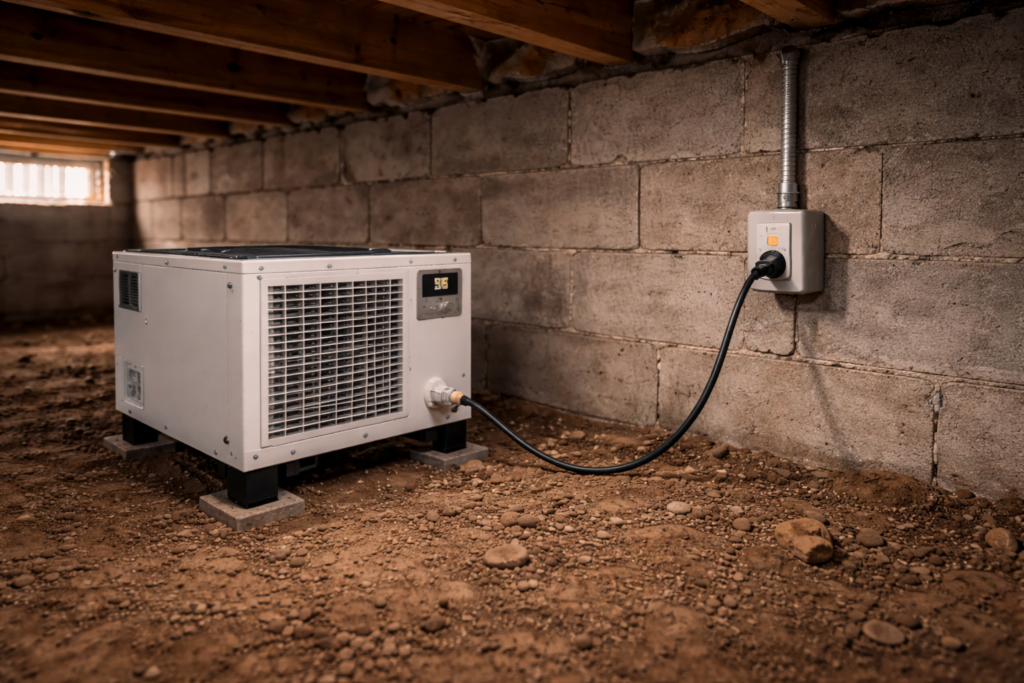
In many cases, a dedicated circuit is recommended for a crawl space dehumidifier, especially if the unit is higher capacity, runs for long periods, has a pump, or will be installed as a permanent crawl space moisture-control system. A smaller unit may work on an existing properly rated outlet, but the safest answer depends on the dehumidifier’s amperage, the circuit rating, and what else is already using that circuit.
Crawl space dehumidifiers are not like small appliances that run for a few minutes and then stop. They may run for hours during humid weather, restart under load, and operate in a damp, hard-to-access area. That is why electrical setup should be planned before installation, not treated as an afterthought.
Why the Electrical Setup Matters
A crawl space dehumidifier can place a steady load on the circuit, especially during humid conditions when the unit needs to run often. If the same circuit is already powering lights, outlets, tools, a sump pump, HVAC equipment, or other appliances, adding a dehumidifier may increase the chance of nuisance tripping or overload.
The issue is not only the running load. Some dehumidifiers can draw more power when the compressor starts. If the circuit is already close to its limit, that startup demand can be enough to trip a breaker or cause unreliable operation.
This matters more with mid-size and larger crawl space dehumidifiers. Units used in 1,500 sq ft, 2,000 sq ft, wet, encapsulated, or commercial-style crawl spaces are more likely to need careful electrical planning than a small compact unit used in a mildly damp area.
If you are still choosing the unit size, see What Size Dehumidifier Do I Need for a Crawl Space? and How Many Pints Should a Crawl Space Dehumidifier Be?.
When a Dedicated Circuit Is Recommended
A dedicated circuit is usually worth considering when the crawl space dehumidifier is a larger unit, will run often, or will be part of a permanent crawl space setup. It is also more important when the existing outlet circuit already serves other equipment.
A dedicated circuit is especially sensible if the dehumidifier is installed in a sealed or encapsulated crawl space where humidity control is expected to operate long term. In that situation, the dehumidifier is not a temporary appliance. It becomes part of the home’s moisture-control system.
It is also a good idea to consider a dedicated circuit if the crawl space is large, damp, or difficult to dry. A unit working in those conditions may run longer and place more consistent demand on the electrical system.
For product comparisons in larger spaces, see Best Crawl Space Dehumidifier for 1,500 sq ft and Best Crawl Space Dehumidifier for 2,000 sq ft.
When a Dedicated Circuit May Not Be Necessary
A dedicated circuit may not always be necessary for a smaller crawl space dehumidifier, especially if the unit has a lower electrical draw, the outlet is properly rated, and the circuit is not shared with other meaningful loads.
However, this should not be guessed. You need to check the dehumidifier’s electrical rating, the breaker size, the outlet type, and what else is connected to the same circuit. If the circuit already serves other appliances or equipment, the dehumidifier may push the total load too high.
For a compact crawl space setup, the electrical demand may be lower than a larger heavy-duty unit, but the same basic rule applies: the outlet and circuit must match the unit’s requirements.
If your crawl space is small or tight, see Best Crawl Space Dehumidifier for Small Crawl Spaces.
Check the Dehumidifier Manual First
The dehumidifier manual or product label should be the first place you check. Look for the voltage, amperage, wattage, plug type, grounding requirement, and any warning about extension cords or shared outlets.
Do not assume that two crawl space dehumidifiers have the same electrical needs just because they are both listed as 70-pint, 90-pint, or crawlspace-rated units. Electrical draw can vary by model, compressor design, pump setup, and control features.
If the manual says the unit must be connected to a dedicated circuit, properly grounded outlet, or specific type of receptacle, follow the manufacturer’s instructions. If the instructions are unclear, ask a licensed electrician before installing the unit.
If you are still comparing products, see Best Crawl Space Dehumidifier.
GFCI Protection in Crawl Spaces
Crawl spaces are often damp or moisture-prone areas, so GFCI protection is an important safety consideration. Depending on local electrical code and the specific installation, crawl space outlets may need GFCI protection.
GFCI protection is designed to reduce shock risk if a fault occurs. That matters in crawl spaces because dehumidifiers involve both electricity and water removal. Drain hoses, condensate pumps, damp ground, and limited access all make safe installation more important.
The exact requirement can depend on the home, jurisdiction, outlet location, and current electrical code used in your area. A licensed electrician can confirm whether the crawl space outlet is properly grounded, GFCI-protected, and suitable for the dehumidifier you plan to use.
Do not bypass GFCI protection to stop nuisance tripping. If the unit trips a GFCI or breaker repeatedly, that is a problem to diagnose, not something to ignore.
Avoid Extension Cords and Power Strips
A crawl space dehumidifier should normally plug directly into a properly rated, properly grounded outlet. Avoid standard extension cords, power strips, surge protectors, multi-outlet adapters, and lightweight cords.
Extension cords can create problems because the dehumidifier may run for long periods and draw a steady load. If the cord is not suitable for the appliance, it can overheat, reduce voltage, or create an unsafe setup in an already damp environment.
A power strip is also a poor choice because it encourages multiple devices to share the same connection. A dehumidifier should not be treated like a phone charger or small electronic device.
If the cord cannot reach a suitable outlet, the better fix is usually to have a properly located outlet installed by a qualified electrician, not to stretch an extension cord across the crawl space.
Electrical Setup and Drainage Should Be Planned Together
Electrical setup and drainage should be planned at the same time. The best dehumidifier location for airflow may not be the best location for an outlet, drain hose, sump, or discharge point.
If you place the dehumidifier only where there is power, drainage may become awkward. If you place it only where drainage is easy, airflow may be poor. A good installation balances power access, drainage route, airflow, and service access.
This is especially important for pump-equipped units. A condensate pump may make drainage more flexible, but the dehumidifier still needs a safe electrical setup and a planned discharge route.
For placement and drainage help, see Where Should You Place a Dehumidifier in a Crawl Space?, Do Crawl Space Dehumidifiers Need a Drain Line?, and Gravity Drain vs Pump Drain for Crawl Space Dehumidifiers.
Dedicated Circuit vs Shared Circuit
A dedicated circuit serves the dehumidifier without other outlets or appliances sharing the same electrical load. This can make sense when the unit is expected to run often, draw higher amperage, or operate as part of a permanent crawl space moisture-control system.
A shared circuit may be acceptable for some smaller units if the total load is low and the outlet is properly rated. The risk is that another device on the same circuit can push the total load too high, causing breaker trips or unreliable operation.
For example, a crawl space dehumidifier sharing a circuit with a sump pump, freezer, power tools, lighting, or other equipment may create more risk than a dehumidifier on a lightly used circuit.
The safest approach is to check the total circuit load before installation. If you are unsure what else is on the circuit, have an electrician trace and evaluate it.
Signs the Electrical Setup May Be Wrong
If the breaker trips when the dehumidifier starts, runs, or cycles with other equipment, the circuit may be overloaded or unsuitable for the unit. Repeated trips should not be ignored.
Other warning signs include a warm outlet, damaged plug, flickering lights, burning smell, buzzing, frequent GFCI trips, or a dehumidifier that shuts off unexpectedly. These are not normal operating issues to work around.
If any of these problems occur, stop using the unit until the electrical setup has been checked. A crawl space can be difficult to access, so electrical problems may go unnoticed longer than they would in a living area.
When in doubt, treat electrical issues as a safety problem, not just an inconvenience.
What to Check Before Installation
- Manufacturer requirements: Check the manual or product label for voltage, amperage, grounding, plug type, and circuit guidance.
- Breaker size: Confirm that the circuit is properly rated for the dehumidifier and any other loads on the same circuit.
- Shared loads: Identify whether lights, outlets, pumps, freezers, tools, or other appliances are already using the circuit.
- Outlet condition: The outlet should be properly grounded, in good condition, and suitable for the environment.
- GFCI protection: Confirm whether GFCI protection is required or already installed for the crawl space outlet.
- Drainage location: Keep drain hoses, pump lines, and discharge routes away from electrical cords and connections.
- Service access: Make sure the unit, outlet, drain line, and pump area can be inspected after installation.
The main mistake is treating power as separate from placement. A crawl space dehumidifier needs a safe outlet, a suitable circuit, a reliable drain route, and enough access for maintenance.
Frequently Asked Questions
Does a crawl space dehumidifier need its own circuit?
Not always, but a dedicated circuit is often recommended for mid-size, high-capacity, pump-equipped, or permanently installed crawl space dehumidifiers. The answer depends on the unit’s electrical rating, the circuit rating, and what else is already on the circuit.
Can I plug a crawl space dehumidifier into a normal outlet?
Some crawl space dehumidifiers can use a standard properly grounded outlet if the outlet and circuit meet the manufacturer’s requirements. Larger units may need a more carefully planned electrical setup, and some installations may justify a dedicated circuit.
Can I use an extension cord for a crawl space dehumidifier?
In general, avoid extension cords for crawl space dehumidifiers. The safer setup is to plug the unit directly into a properly rated, grounded outlet that meets the manufacturer’s instructions.
Does a crawl space dehumidifier outlet need GFCI protection?
Many crawl space outlets require or benefit from GFCI protection because crawl spaces can be damp environments. Exact requirements depend on local code and the installation, so a licensed electrician should confirm the correct setup.
Why does my dehumidifier trip the breaker?
A dehumidifier may trip a breaker if the circuit is overloaded, the unit draws too much current at startup, the outlet or wiring has a problem, or other devices are sharing the same circuit. Repeated breaker trips should be checked by a qualified electrician.
Final Thoughts
You may not always be required to install a dedicated circuit for a crawl space dehumidifier, but it is often a smart choice for larger, higher-capacity, pump-equipped, or permanent crawl space installations.
Before installing the unit, check the manufacturer’s electrical requirements, the circuit rating, the outlet condition, GFCI protection, and any other loads on the same circuit. Avoid extension cords and power strips, and keep drainage away from electrical connections.
If you are unsure whether the existing outlet is suitable, consult a licensed electrician. That is the safest way to make sure the dehumidifier can run reliably without creating electrical problems in the crawl space.