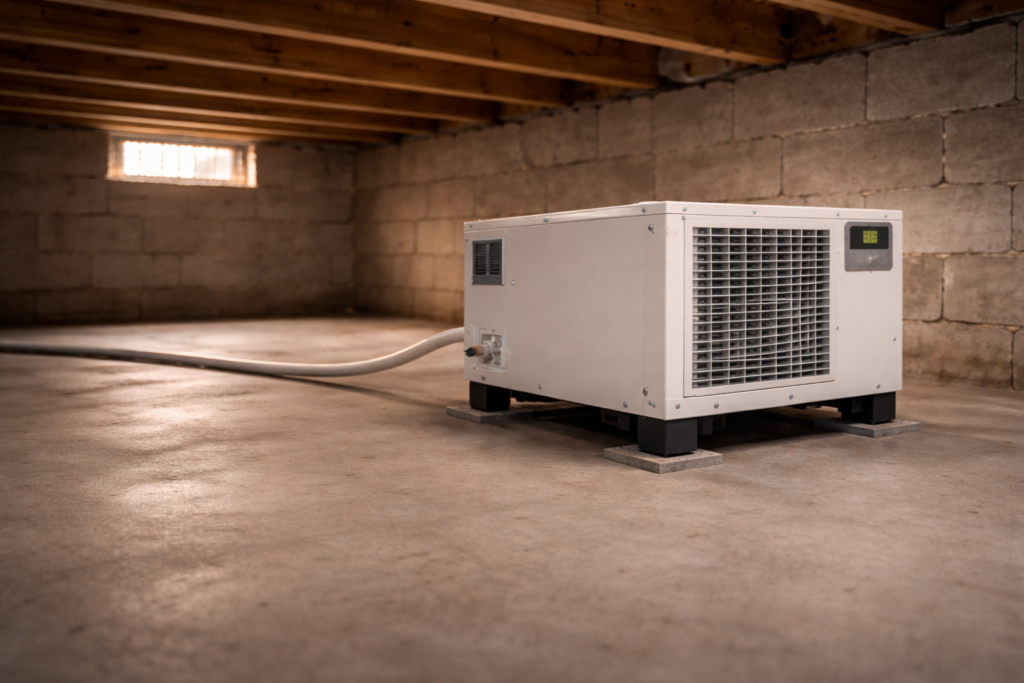
Energy efficiency matters because crawl space dehumidifiers often run for long periods. A unit that removes moisture efficiently can reduce operating costs while maintaining stable humidity levels.
Choosing an efficient model starts with understanding how performance and power use work together.
Look at Moisture Removal per Watt
Energy efficiency is not just about low wattage. It is about how much moisture the unit removes for the electricity it consumes.
A more efficient unit:
-
Removes more pints per kilowatt-hour
-
Reaches target humidity faster
-
Cycles less frequently
-
Operates more steadily
If you are unsure what pint capacity your space requires, review How Many Pints Should a Crawl Space Dehumidifier Be?
For full sizing guidance, see What Size Dehumidifier Do I Need for a Crawl Space?
Energy Star Certification
Many crawl space dehumidifiers carry Energy Star certification.
Energy Star models typically:
-
Meet federal efficiency standards
-
Use improved compressor systems
-
Optimize airflow design
While certification is not the only indicator of efficiency, it provides a useful baseline.
Proper Sizing Improves Efficiency
An oversized unit may short cycle. An undersized unit may run constantly.
Both reduce overall efficiency.
Proper sizing ensures:
-
Stable humidity
-
Predictable runtime
-
Lower long-term energy waste
For a step-by-step selection framework, read How to Choose a Crawl Space Dehumidifier.
Adjustable Humidistat Control
Efficiency improves when the unit maintains a consistent humidity range rather than operating at maximum output all the time.
Look for:
-
Adjustable humidity settings
-
Digital humidistat controls
-
Automatic cycling
The ideal target range is:
45%–55% relative humidity
Setting the humidity too low can increase runtime and energy cost.
Airflow and Design
Efficient airflow matters as much as compressor performance.
Look for:
-
Balanced intake and exhaust design
-
Clear airflow path
-
Proper installation clearance
Placement can also affect energy efficiency. For guidance, see Where Should You Place a Dehumidifier in a Crawl Space?
Low-Temperature Operation
Crawl spaces often run cooler than living areas. Units designed for low temperatures maintain efficiency without freezing up.
If your crawl space experiences colder seasons, compare models in Best Low Temperature Crawl Space Dehumidifier.
Long-Term Cost Perspective
Operating cost depends on:
-
Wattage
-
Daily runtime
-
Electricity rates
If you want to estimate running costs, see How Much Does It Cost to Run a Crawl Space Dehumidifier?
Reducing moisture sources — such as improving drainage or sealing air leaks — can also reduce runtime and energy use.
Final Thoughts
Energy efficient crawl space dehumidifiers combine:
-
Proper sizing
-
High moisture removal per watt
-
Adjustable humidity control
-
Low-temperature capability
-
Good airflow design
Efficiency is not just about electricity use — it is about how effectively the unit maintains stable humidity without running constantly.
When properly matched to your crawl space, an energy-efficient model can provide reliable moisture control with predictable operating costs.