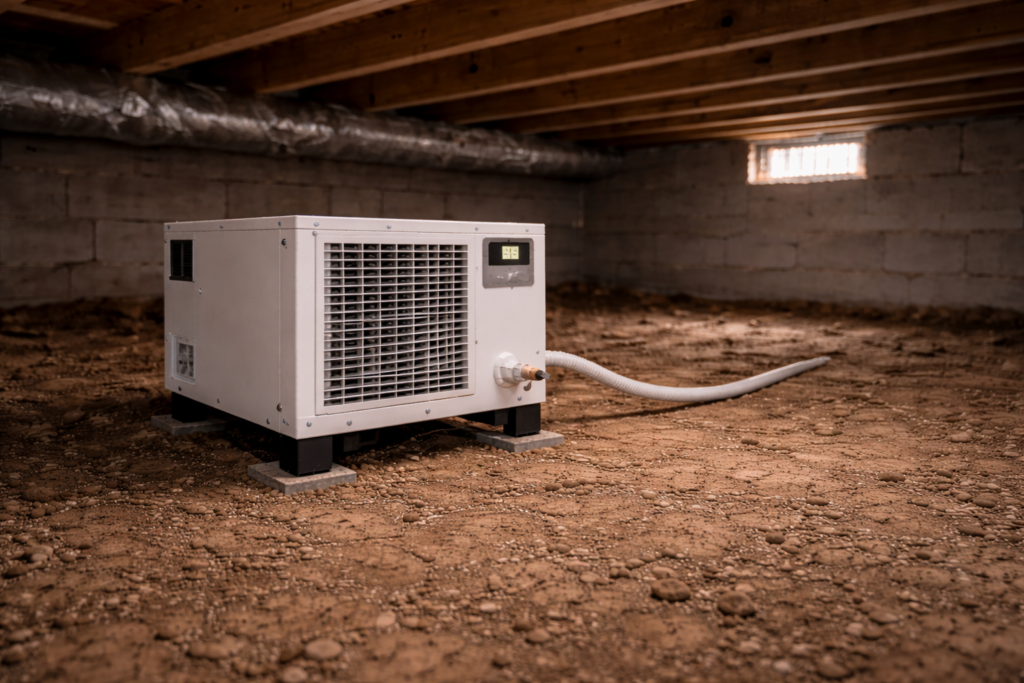
No — a properly sized crawl space dehumidifier should not run all the time once the crawl space has stabilized. It may run for long periods at first, especially if the space is damp, but it should eventually cycle on and off to maintain the target humidity range.
If a crawl space dehumidifier runs constantly for weeks and never brings humidity under control, that usually points to a sizing, placement, drainage, air leak, or moisture-intrusion problem. The unit may not be wrong, but something in the crawl space setup needs to be checked.
What Normal Operation Looks Like
Normal operation depends on the crawl space, the weather, and how damp the area was before the dehumidifier was installed. A unit may run more often during the first few days or weeks because it is drying out wood framing, insulation, soil moisture, and humid air trapped in the space.
Once the crawl space stabilizes, the dehumidifier should usually cycle. That means it turns on when humidity rises, runs until the target setting is reached, and then shuts off until humidity climbs again.
- Initial drying period: Longer run times are normal when the unit is first installed.
- Humid seasons: The unit may run more often in warm, wet, or humid weather.
- Stable conditions: The unit should cycle on and off once the crawl space is under control.
- Drier months: Runtime may decrease when outdoor humidity is lower.
The goal is not for the dehumidifier to run nonstop. The goal is to keep crawl space humidity stable without the unit working harder than necessary.
For target humidity guidance, see Ideal Humidity Level for a Crawl Space.
When Continuous Running Can Be Normal
Continuous running can be normal for a short period after installation. If the crawl space was damp before the dehumidifier was added, the unit may need time to remove moisture from the air, framing, ground cover, insulation, and stored materials.
This is especially common after encapsulation, after a wet season, or after fixing a moisture problem. The dehumidifier may run heavily while the space dries down to the target humidity level.
It can also run more often during humid summer weather, heavy rain periods, or times when outdoor moisture is entering the crawl space. A vented crawl space will usually be harder to control than a sealed crawl space because humid outdoor air can keep entering.
If the unit eventually reaches the target humidity and starts cycling, the longer initial runtime is usually not a concern.
If the dehumidifier runs constantly and still cannot bring humidity under control, the unit may be undersized for the moisture load. In heavier-duty situations, compare options in our best commercial crawl space dehumidifier guide.
When Constant Running Is a Problem
Constant running becomes a problem when the dehumidifier never reaches the target humidity, runs continuously for weeks, or keeps the crawl space damp despite operating every day.
In that situation, the issue is usually one of these:
- The unit is undersized: It may not have enough capacity for the crawl space size or moisture load.
- The crawl space is poorly sealed: Humid outdoor air may keep entering through vents, gaps, or leaks.
- There is bulk water: Standing water, wet soil, or drainage problems may be adding more moisture than the unit can handle.
- The unit is poorly placed: Bad placement can stop dry air from reaching the whole crawl space.
- The drain setup is failing: A clogged hose, bad slope, or pump issue can prevent proper water removal.
- The humidity setting is too low: Setting the target too aggressively can make the unit run longer than necessary.
If you are unsure whether the unit is large enough, see What Size Dehumidifier Do I Need for a Crawl Space? and How Many Pints Should a Crawl Space Dehumidifier Be?.
Sealed vs Vented Crawl Spaces
A sealed or encapsulated crawl space usually gives a dehumidifier a better chance of cycling normally. When outside air, exposed ground moisture, and major leaks are controlled, the unit is mainly maintaining humidity rather than constantly fighting new moisture.
A vented crawl space can be different. In humid weather, vents may allow damp outdoor air to enter the crawl space. That can make the dehumidifier run longer because the space keeps receiving new moisture from outside.
This is why two homes can use the same dehumidifier and get different results. A sealed crawl space may stabilize quickly, while a vented crawl space in a humid climate may cause the unit to run much more often.
If your crawl space is sealed or encapsulated, see Do You Need a Dehumidifier in a Sealed Crawl Space? and Best Dehumidifier for Encapsulated Crawl Space.
Could the Dehumidifier Be Too Small?
An undersized crawl space dehumidifier may run all the time because it cannot remove moisture fast enough. This is common when a small or standard room dehumidifier is used in a damp crawl space that really needs a crawlspace-rated unit.
A dehumidifier can also be undersized for the actual moisture load, even if the square footage seems reasonable. A 1,000 sq ft crawl space with heavy moisture can be harder to control than a larger sealed crawl space with mild humidity.
Signs the unit may be too small include constant runtime, humidity that never reaches the target, musty odors that do not improve, and damp conditions that return quickly after the unit shuts off.
If you need to compare product options, see Best Crawl Space Dehumidifier, Best Crawl Space Dehumidifier for 1,500 sq ft, and Best Crawl Space Dehumidifier for 2,000 sq ft.
Could the Dehumidifier Be Poorly Placed?
Placement can affect how long a crawl space dehumidifier runs. If the unit is tucked into a corner, blocked by piers, placed behind insulation, or installed where air cannot move freely, it may dry the nearby area but struggle to control the whole crawl space.
A good location should allow the unit to pull in damp air, discharge dry air, drain properly, and remain accessible for maintenance. In a divided crawl space, one unit may not move air evenly through every section unless placement is planned carefully.
If the dehumidifier runs constantly but humidity readings vary across the crawl space, airflow or placement may be part of the problem.
For placement guidance, see Where Should You Place a Dehumidifier in a Crawl Space?.
Drainage Problems Can Increase Runtime
A crawl space dehumidifier needs reliable drainage. If the drain hose is kinked, clogged, poorly sloped, disconnected, or routed incorrectly, the unit may not remove water properly.
Some units may shut off, fill a reservoir, or operate inefficiently if drainage is not working as intended. Pump-equipped models also need a clear discharge route and occasional inspection.
Drainage matters because the dehumidifier is only useful if the collected water leaves the crawl space. If water is draining back near the foundation or into the crawl space, the unit may keep fighting the same moisture again and again.
For drainage help, see Do Crawl Space Dehumidifiers Need a Drain Line?, Gravity Drain vs Pump Drain for Crawl Space Dehumidifiers, and Best Crawl Space Dehumidifier with Pump.
How Humidity Settings Affect Runtime
The humidity setting can also affect how often the dehumidifier runs. If the target is set too low, the unit may run longer than necessary trying to reach a level that is difficult to maintain in that crawl space.
Most homeowners are trying to prevent dampness, musty odors, condensation, and mold-friendly conditions. They are not trying to make the crawl space extremely dry.
If the unit is set very low and runs constantly, try checking whether the target humidity is realistic for the crawl space conditions. A properly matched setting can help the unit cycle more normally while still keeping moisture under control.
For more detail, see Ideal Humidity Level for a Crawl Space and Can a Crawl Space Be Too Dry?.
Running Cost and Energy Use
A crawl space dehumidifier that runs constantly will usually cost more to operate than one that cycles normally. Some extra runtime is expected during humid periods, but nonstop operation can increase energy use if the unit is undersized, poorly placed, or fighting outside moisture.
Energy use should be judged alongside results. If the unit runs often but keeps humidity stable, that may be acceptable during a humid season. If it runs constantly and humidity stays high, the system is not working efficiently.
For more help, see How Much Does It Cost to Run a Crawl Space Dehumidifier? and Best Energy Efficient Crawl Space Dehumidifier.
What to Check If the Unit Never Shuts Off
- Humidity reading: Confirm the crawl space humidity with a separate hygrometer if possible.
- Humidity setting: Make sure the target is realistic and not set unnecessarily low.
- Drain hose: Check for clogs, kinks, poor slope, or disconnected hose sections.
- Airflow: Make sure the unit is not blocked by walls, piers, insulation, stored items, or ground cover.
- Filter condition: A dirty filter can reduce airflow and make the unit work harder.
- Crawl space vents: Open vents or air leaks may keep adding humid air.
- Standing water: A dehumidifier should not be expected to solve bulk water problems by itself.
- Unit size: The dehumidifier may not be matched to the crawl space size or moisture load.
If the crawl space is still damp after checking these basics, the issue may be larger than runtime alone. See Why Is My Crawl Space Still Damp After Using a Dehumidifier?.
Frequently Asked Questions
Should a crawl space dehumidifier run constantly?
No, not under normal stabilized conditions. It may run for long periods at first or during very humid weather, but it should usually cycle on and off once the crawl space reaches the target humidity.
How long should a crawl space dehumidifier run after installation?
It may run heavily for several days or longer if the crawl space was very damp. Runtime should gradually decrease once the space dries and humidity stabilizes.
Why does my crawl space dehumidifier never shut off?
Common reasons include an undersized unit, poor placement, clogged drainage, dirty filter, open vents, heavy moisture intrusion, or a humidity setting that is too low.
Is it bad for a crawl space dehumidifier to run all day?
Running all day can be normal during initial drying or very humid weather. It becomes a concern if the unit runs constantly for weeks and still cannot reach the target humidity.
Will a bigger dehumidifier run less often?
Sometimes, but bigger is not always better. A larger unit may help if the current one is undersized, but moisture intrusion, poor drainage, or bad placement should also be fixed.
Final Thoughts
A crawl space dehumidifier should not run all the time once the crawl space is stable. It should run when humidity rises, shut off when the target level is reached, and restart when moisture builds again.
Continuous runtime is normal during initial drying or very humid weather. It is not normal if the dehumidifier runs constantly for weeks and the crawl space stays damp.
If your unit never shuts off, check the humidity setting, unit size, filter, drainage route, placement, vents, and moisture sources. A dehumidifier works best when it is matched to the crawl space and supported by proper drainage, airflow, sealing, and moisture control.