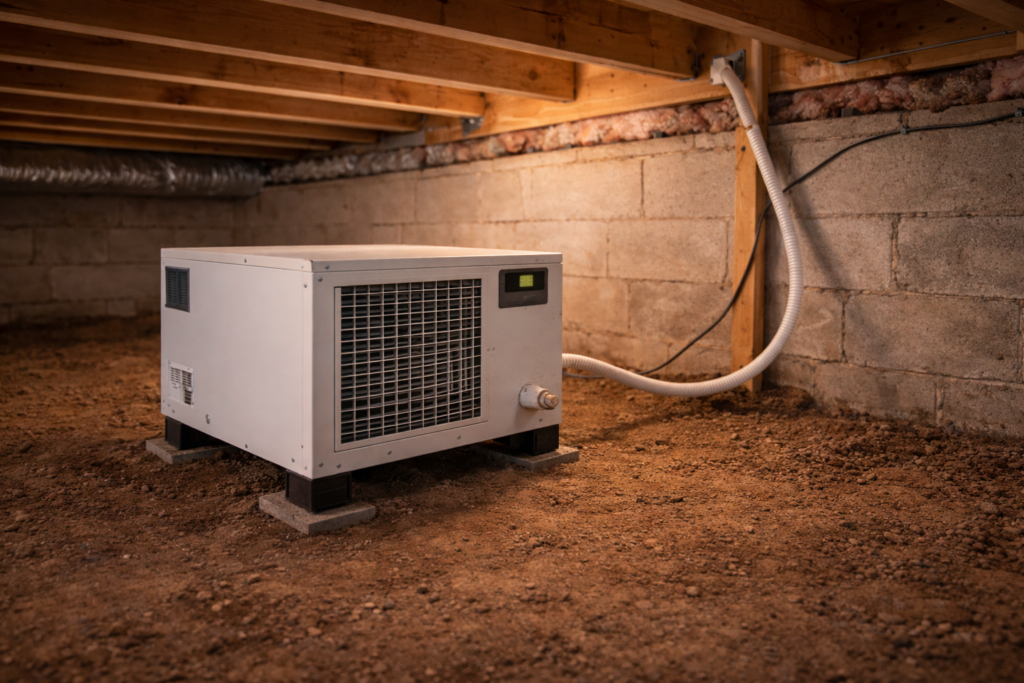
The best crawl space dehumidifier with pump is a crawlspace-rated unit that can remove moisture continuously and move collected water away when gravity drainage is not practical. For most homeowners who specifically need pump drainage, the BaseAire AirWerx 35P 70-Pint Crawlspace Dehumidifier with Pump is the strongest starting point, while the best final choice depends on crawl space size, moisture severity, drainage route, and whether the space needs a compact or heavy-duty setup.
A built-in pump can make installation more flexible, but it does not remove the need for proper drainage planning. The pump still needs a clear hose route, a suitable discharge point, enough clearance around the unit, and a safe electrical setup.
If you need both higher capacity and pump drainage, a commercial-style crawl space dehumidifier may be the better fit. See our best commercial crawl space dehumidifier guide for heavier-duty pump and crawlspace-rated options.
Quick Picks
- Best overall for pump drainage: BaseAire AirWerx 35P 70-Pint Crawlspace Dehumidifier with Pump
- Best for smaller crawl spaces: BaseAire Crawlspace Dehumidifier with Pump
- Best for heavy-duty pump drainage: ALORAIR 180-Pint Crawlspace Dehumidifier with Pump
If your crawl space is around 1,500 sq ft, pump drainage can be useful when gravity drainage is awkward or impossible. Our best crawl space dehumidifier for 1,500 sq ft guide includes pump-equipped and non-pump options for this size range.
If your crawl space is around 2,000 sq ft, drainage becomes even more important because the best location for airflow may not be the easiest location for a drain hose. Compare the pump-equipped and non-pump options in our 2,000 sq ft crawl space dehumidifier guide.
Do You Actually Need a Pump?
You need a pump when the dehumidifier cannot drain water downward by gravity to a suitable discharge point. This can happen when the crawl space does not have a nearby floor drain, sump pit, or downhill drain route.
A pump-equipped crawl space dehumidifier can move collected water upward or across a longer route, which gives you more flexibility when placing the unit. This is useful when the best location for airflow is not close to the easiest drainage location.
You may not need a pump if the dehumidifier can drain continuously downhill through a hose to a safe discharge point. Gravity drainage is usually simpler because it has fewer moving parts, but it only works when the crawl space layout allows it.
For a deeper comparison, see Gravity Drain vs Pump Drain for Crawl Space Dehumidifiers and Do Crawl Space Dehumidifiers Need a Drain Line?.
BaseAire AirWerx 35P 70-Pint Crawlspace Dehumidifier with Pump
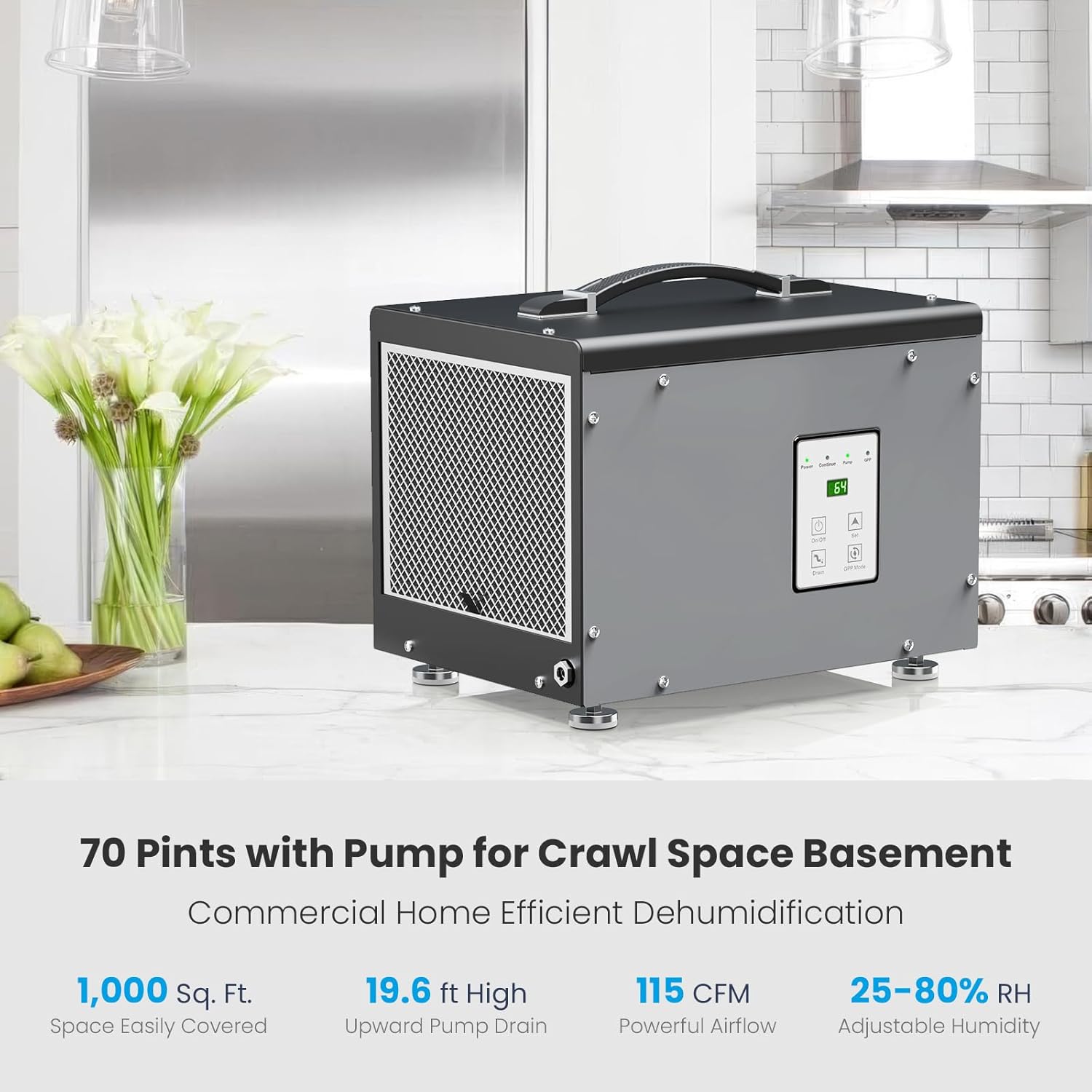
A pump-equipped crawl space dehumidifier for homes where gravity drainage is not practical.Check current price
The BaseAire AirWerx 35P 70-Pint Crawlspace Dehumidifier with Pump is the best overall choice on this page because it directly matches the main buyer intent: a crawl space dehumidifier with built-in pump drainage. It is best suited to homeowners who need continuous moisture removal but do not have a simple downward drain path available.
Best for: Most crawl spaces where the dehumidifier needs to pump water to a sump area, drain route, or suitable discharge location instead of relying on gravity.
Why it fits pump-drainage situations: The built-in pump gives the buyer more flexibility when planning the discharge route. This can make installation easier when the unit needs to sit in the best airflow location rather than directly beside a gravity drain.
Main limitation: The pump still needs a clear, reliable hose path and suitable discharge point. Buyers should plan the drainage route before choosing the final installation location.
Choose this if: You want the most practical all-round option for a crawl space where gravity drainage is not convenient.
Skip this if: Your crawl space already has a simple downhill drain path and you want the simplest setup possible.
BaseAire Crawlspace Dehumidifier with Pump

A practical pump-equipped crawlspace option for smaller areas and simpler moisture-control setups.Check current price
The BaseAire Crawlspace Dehumidifier with Pump is the simpler option in this pump-focused lineup. It makes the most sense for buyers with smaller crawl spaces, easier layouts, or moisture problems that do not justify moving straight to a larger heavy-duty unit.
Best for: Smaller crawl spaces, moderate moisture control, and buyers who want a pump-equipped unit without choosing the largest model on the page.
Why it fits smaller crawl spaces: A compact crawl space may still have an awkward drain route. This option keeps the focus on crawl space use and pump drainage while staying better suited to simpler setups.
Main limitation: It may not be the right match for a large, very damp, or repeatedly wet crawl space where a higher-capacity dehumidifier would be more appropriate.
Choose this if: Your crawl space is smaller, tighter, or moderately damp, but you still need pump drainage.
Skip this if: The crawl space is large, wet, musty, vented, or difficult to dry.
For compact-space options, see Best Crawl Space Dehumidifier for Small Crawl Spaces.
ALORAIR 180-Pint Crawlspace Dehumidifier with Pump

A high-capacity pump-equipped option for larger crawl spaces and heavier moisture problems.Check current price
The ALORAIR 180-Pint Crawlspace Dehumidifier with Pump is the heavy-duty choice for buyers who need more capacity and pump drainage in the same unit. It is the better direction for larger crawl spaces, persistent dampness, or installations where a smaller unit may need to run too often to keep up.
Best for: Large crawl spaces, heavy moisture loads, and homeowners who want a stronger pump-equipped setup.
Why it fits heavy-duty crawl spaces: It combines high-capacity positioning with pump drainage, which is useful when both moisture removal and water discharge are major concerns.
Main limitation: It may be unnecessary for a small or mildly damp crawl space, and buyers should avoid oversizing if the moisture problem is limited.
Choose this if: The crawl space is large, wet, musty, repeatedly damp, or difficult to dry.
Skip this if: Your crawl space is small, sealed, mildly humid, or already easy to control with a smaller crawlspace-rated unit.
For heavier-duty options, see Best Commercial Crawl Space Dehumidifier.
Built-In Pump vs Gravity Drain
A gravity drain is usually the simpler setup when the dehumidifier can drain continuously downhill to a suitable location. It has fewer moving parts and can work well when the crawl space layout makes the drain route easy.
A built-in pump is useful when gravity drainage is not practical. This can happen if the discharge point is higher than the dehumidifier, if the hose route needs to travel across the crawl space, or if the best dehumidifier location is not close to a drain.
The mistake is buying a pump model only because it sounds better. A pump is useful when the installation requires it. If gravity drainage works, a pump may add complexity that is not needed.
For the full comparison, read Gravity Drain vs Pump Drain for Crawl Space Dehumidifiers.
How to Plan the Pump Discharge Route
Before buying a pump-equipped crawl space dehumidifier, decide where the water will go. The pump needs a hose route that is clear, secure, protected from damage, and directed to a suitable discharge point.
The discharge route should not create standing water near the foundation or send water somewhere it can flow back into the crawl space. It should also avoid sharp bends, crushed hose sections, or locations where the line could be accidentally knocked loose.
Placement matters because the best location for moisture control may not be the easiest location for drainage. Try to choose a position that balances airflow, hose routing, electrical access, and future maintenance.
For placement help, see Where Should You Place a Dehumidifier in a Crawl Space? and How to Install a Crawl Space Dehumidifier.
Electrical Setup for Pump-Equipped Units
A pump-equipped crawl space dehumidifier needs a safe electrical setup because it may run for long periods and may be installed in a damp environment. The unit should plug into a properly rated outlet that matches the manufacturer’s requirements.
Do not rely on a standard extension cord or power strip for a crawl space dehumidifier. If the cord cannot reach a suitable outlet, the safer solution is usually to have the outlet location reviewed or installed properly.
Larger or permanent installations may also need more careful circuit planning. If the unit is high-capacity, pump-equipped, or expected to run often, check whether the existing circuit is suitable before installation.
For more detail, see Do You Need a Dedicated Circuit for a Crawl Space Dehumidifier?.
What to Look For
- Confirm that you actually need a pump: If the unit can drain downward to a suitable drain point, a pump may not be necessary.
- Plan the discharge route first: A built-in pump does not remove the need for good drainage planning. The hose still needs a safe, clear path to an appropriate discharge location.
- Match capacity to moisture load: A smaller pump-equipped unit may suit a compact crawl space, while a large or repeatedly damp crawl space may need a higher-capacity option.
- Check access for maintenance: Pump-equipped units still need filter checks, hose checks, and occasional inspection.
- Think about crawl space height and placement: A pump can solve drainage problems, but the unit still needs enough clearance, stable positioning, and proper airflow.
- Plan electrical and drainage together: The unit needs safe power access and a suitable hose route, not just one or the other.
The pump is only one part of the decision. Capacity, crawl space size, moisture level, drainage route, electrical setup, and maintenance access all affect whether the unit is the right match.
Frequently Asked Questions
Do I need a crawl space dehumidifier with a pump?
You need a pump if gravity drainage is not practical. If the hose can drain downhill to a safe discharge point, a gravity drain may work. If the water needs to move upward or across an awkward route, a pump-equipped unit is usually easier to install.
Is a built-in pump better than gravity drainage?
Not always. A built-in pump is better when gravity drainage is not possible or convenient. Gravity drainage is usually simpler if the crawl space layout allows the water to drain continuously downhill.
Where should the pump hose drain?
The hose should discharge to a suitable location where water will not flow back into the crawl space or collect near the foundation. The exact discharge point depends on the home, crawl space layout, and local drainage setup.
Can a pump-equipped dehumidifier handle a large crawl space?
It depends on the unit’s capacity and the moisture load. A pump helps move water away, but it does not automatically mean the dehumidifier is large enough. For large or wet crawl spaces, choose both suitable capacity and a suitable drainage setup.
Does a pump-equipped dehumidifier need maintenance?
Yes. The filter, hose route, pump area, and discharge line should be checked periodically. A pump-equipped unit can be very useful, but the drainage path still needs to stay clear and secure.
Final Recommendation
For most homeowners looking for a crawl space dehumidifier with pump, the BaseAire AirWerx 35P 70-Pint Crawlspace Dehumidifier with Pump is the best overall choice because it directly fits the main need: crawl space moisture control with built-in pump drainage.
The BaseAire Crawlspace Dehumidifier with Pump is the better alternative for smaller crawl spaces or simpler setups where a heavy-duty unit may be unnecessary. The ALORAIR 180-Pint Crawlspace Dehumidifier with Pump is the stronger option for large, damp, or more demanding crawl spaces where both capacity and pump drainage matter.
Avoid choosing a pump model only because it sounds more complete. Choose a pump-equipped crawl space dehumidifier when the drainage route actually requires it, then match the capacity to the size and moisture level of the crawl space.
Related Guides
- Do Crawl Space Dehumidifiers Need a Drain Line?
- Gravity Drain vs Pump Drain for Crawl Space Dehumidifiers
- How to Install a Crawl Space Dehumidifier
- Where Should You Place a Dehumidifier in a Crawl Space?
- Do You Need a Dedicated Circuit for a Crawl Space Dehumidifier?
- Best Crawl Space Dehumidifier for 1,500 sq ft
- Best Crawl Space Dehumidifier for 2,000 sq ft
- Best Crawl Space Dehumidifier