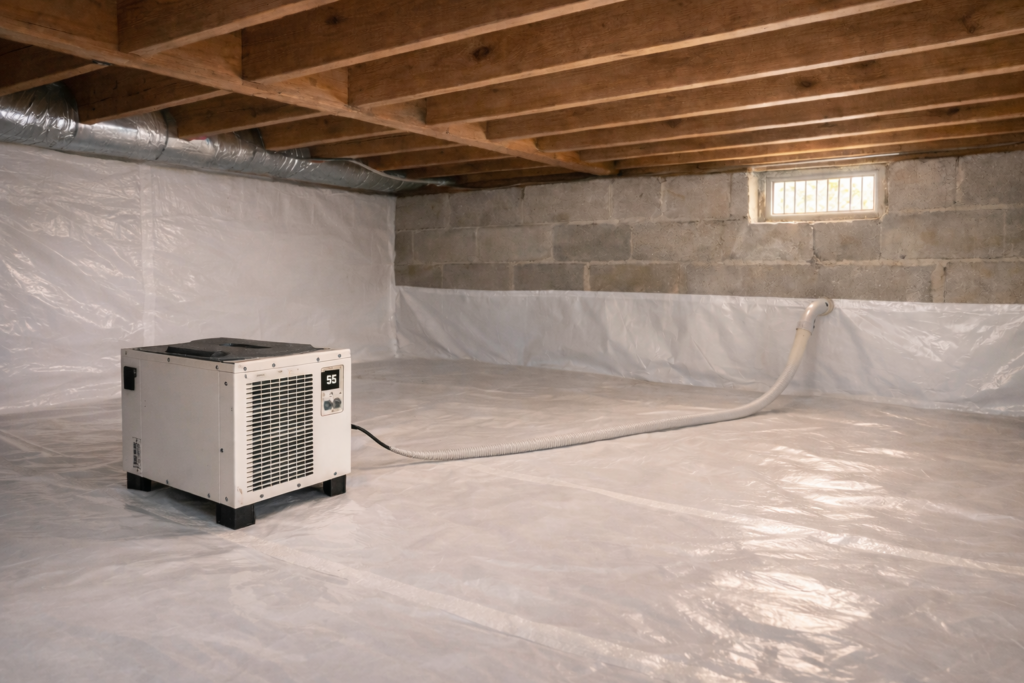
Most crawl space problems are caused by excess moisture, not dryness. However, it is possible for a crawl space to become too dry under certain conditions.
In general, the ideal humidity range for a crawl space is:
45%–55% relative humidity
If humidity consistently drops well below this range, minor issues can develop over time.
What Happens If a Crawl Space Is Too Dry?
When humidity falls below 35%–40% for extended periods, you may notice:
-
Slight wood shrinkage
-
Minor gaps in subfloor boards
-
Increased dust levels
-
More frequent dehumidifier cycling
Wood framing naturally expands and contracts with moisture changes. Extremely dry air can cause minor dimensional movement, though serious structural damage from dryness alone is uncommon.
For recommended humidity targets, see Ideal Humidity Level for a Crawl Space.
Why Over-Drying Is Rare
In most regions, crawl spaces are far more likely to be humid than overly dry.
Even with a dehumidifier installed:
-
Outdoor humidity often re-enters
-
Soil moisture slowly releases vapor
-
Seasonal swings increase humidity
If your unit is properly sized, it should cycle off once the set humidity level is reached.
If you are unsure whether your system is correctly matched to your space, review What Size Dehumidifier Do I Need for a Crawl Space?
Signs a Dehumidifier May Be Oversized
A unit that is too large for the crawl space may:
-
Reach target humidity very quickly
-
Short cycle (turn on and off frequently)
-
Maintain humidity well below 40%
Slight oversizing is generally safer than undersizing, but extreme oversizing can lead to inefficient operation.
For a full overview of capacity selection, see How Many Pints Should a Crawl Space Dehumidifier Be?
Sealed Crawl Spaces and Dry Conditions
Encapsulated crawl spaces are easier to control and may occasionally dip below recommended humidity levels during dry winter months.
If your space is sealed, balanced control is more important than aggressive moisture removal.
For more guidance specific to sealed systems, see Do You Need a Dehumidifier in a Sealed Crawl Space?
How to Prevent Over-Drying
To maintain proper balance:
-
Set the humidistat between 45% and 55%
-
Avoid running the unit continuously on manual mode
-
Monitor humidity with a digital hygrometer
-
Check readings seasonally
Most modern crawl space dehumidifiers allow adjustable humidity settings, making it easy to maintain a safe range.
For product comparisons with adjustable controls, see Best Crawl Space Dehumidifier.
Final Thoughts
Yes, a crawl space can technically be too dry, but it is far less common than excess humidity.
As long as humidity remains between 45% and 55%, the environment is generally stable for wood framing and insulation.
The goal is not to make the crawl space as dry as possible. The goal is to keep it consistently balanced.