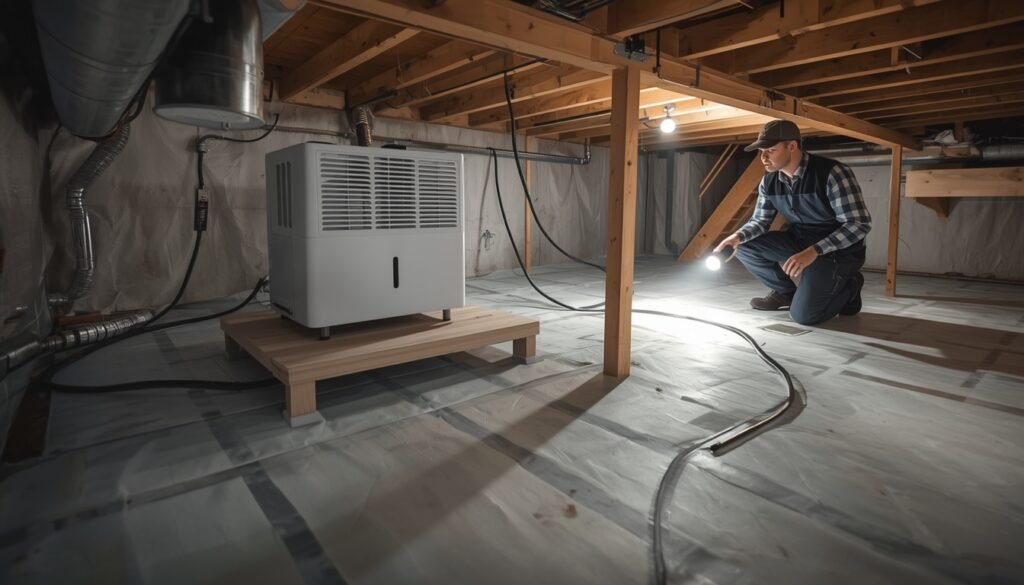
No, a crawl space dehumidifier does not always need a pump. It only needs a pump when the collected water cannot drain away by gravity to a suitable discharge point. If the unit can drain continuously downhill through a hose, a gravity drain may be enough.
The drainage method matters because a crawl space dehumidifier may remove water every day during humid periods. That water needs to leave the crawl space reliably without overflowing, pooling near the foundation, or requiring manual emptying.
How It Works
A crawl space dehumidifier removes moisture from the air and collects that moisture as water. The water then has to leave the unit through a drain hose, internal pump, external pump, or another drainage path.
Gravity drainage works when the hose can slope downward from the dehumidifier to a safe drain location. Pump drainage is used when the water must move upward, across a long route, or to a discharge point that is not lower than the unit.
What It Can Do
A pump can make a crawl space dehumidifier easier to place because the unit does not have to sit directly beside a downhill drain route. This can be useful when the best location for airflow is not the easiest location for drainage.
- Move collected water upward to a higher discharge point
- Send water across the crawl space when a nearby gravity drain is not available
- Allow more flexible dehumidifier placement
- Reduce the need for manual bucket emptying
- Support continuous drainage during humid periods
A pump is most useful when the crawl space layout makes gravity drainage difficult or impossible. It does not make the dehumidifier more powerful, but it can make the installation more practical. If drainage is the main buying concern, compare options in our best crawl space dehumidifier with pump guide.
Limitations and What It Cannot Do
A pump does not remove the need for good drainage planning. The hose still needs a clear route, a suitable discharge point, and protection from kinks, damage, freezing conditions, or accidental disconnection.
A pump also does not fix standing water, leaks, poor grading, or bulk water entering the crawl space. It only moves water collected by the dehumidifier. If the crawl space has puddles or water intrusion after rain, those problems should be corrected separately.
Pump-equipped units can also require more maintenance than gravity-drain setups. The pump area, hose, and discharge line should be inspected periodically to make sure water is leaving the crawl space properly.
When It Works Best
A pump works best when the dehumidifier needs to sit in a good airflow location but the available drain point is too far away, too high, or not suitable for gravity drainage. In that situation, pump drainage gives more installation flexibility.
It is also useful in crawl spaces where the dehumidifier needs to discharge water to a sump area, utility drain, condensate line, or another approved location that is not lower than the unit.
Gravity drainage is usually simpler when the layout allows it. If the drain hose can slope continuously downward to a safe discharge point, a pump may add unnecessary complexity.
Common Misconceptions
One common misconception is that every crawl space dehumidifier needs a pump. That is not true. Many crawl spaces can use gravity drainage if the hose route slopes downward and the discharge point is suitable.
Another misconception is that a pump improves moisture removal. It does not. Moisture removal depends on the dehumidifier’s capacity, airflow, humidity setting, and crawl space conditions. The pump only moves collected water away.
It is also incorrect to assume that a pump solves drainage problems by itself. Poor hose routing, clogged lines, bad discharge locations, and foundation drainage issues can still cause problems even if the unit has a built-in pump.
Final Answer Summary
A crawl space dehumidifier needs a pump only when gravity drainage is not practical. If the unit can drain downhill to a safe location, gravity drainage may be simpler and sufficient.
A pump is useful when water must move upward, across distance, or to a discharge point that is not lower than the dehumidifier. The best choice depends on the crawl space layout, drain route, unit placement, and long-term maintenance access.