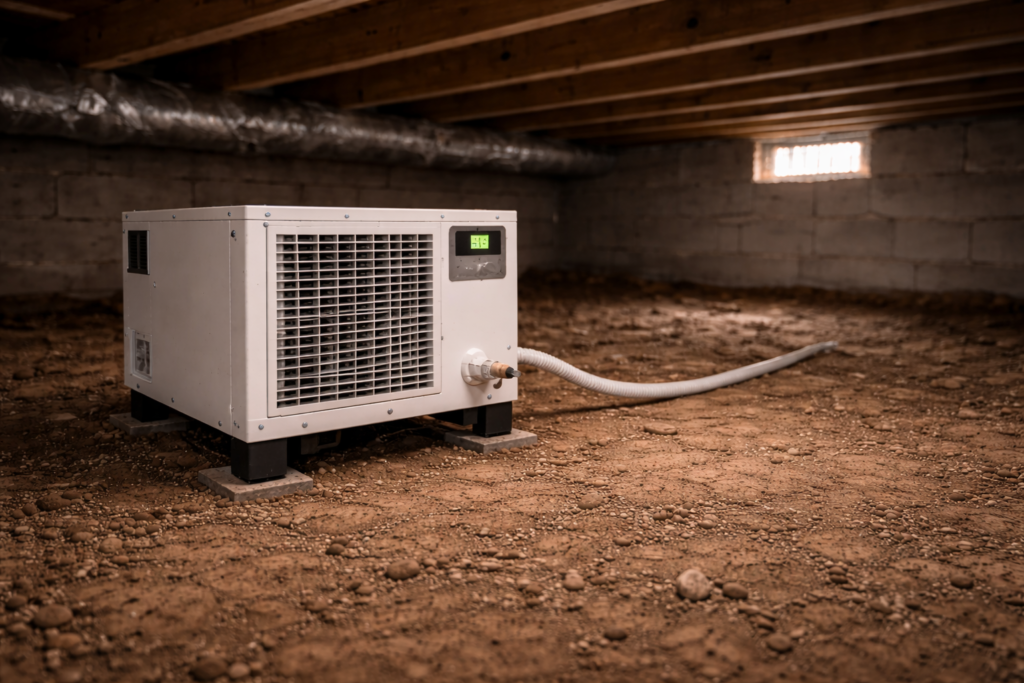
How long a crawl space dehumidifier runs depends on humidity levels, crawl space size, and how well the space is sealed.
There is no fixed number of hours per day that applies to every home. Instead, the goal is consistent humidity control — not constant operation.
In most cases, a properly sized unit should:
-
Run longer during initial drying
-
Cycle on and off once humidity stabilizes
-
Run more during humid seasons
-
Run less during dry or cool periods
During Initial Installation
When first installed, a crawl space dehumidifier may run for several days or even continuously for the first week.
This is normal.
The unit is removing:
-
Trapped moisture in wood framing
-
Moisture in insulation
-
Humidity from soil and air
Once the crawl space reaches the target range, runtime should gradually decrease.
If you’re unsure about proper capacity, review What Size Dehumidifier Do I Need for a Crawl Space?
After Humidity Stabilizes
Once the crawl space reaches 45%–55% relative humidity, the unit should:
-
Turn off once the set point is reached
-
Turn back on as humidity rises
-
Cycle periodically rather than run nonstop
If the unit never shuts off after several weeks, it may be:
-
Undersized
-
Placed incorrectly
-
In a crawl space with high moisture intrusion
For capacity guidance, see How Many Pints Should a Crawl Space Dehumidifier Be?
Seasonal Differences
Runtime changes with the seasons.
Summer (humid months):
-
Longer daily runtime
-
More frequent cycling
Winter (cooler, drier air):
-
Shorter runtime
-
Possible defrost cycles
If low temperatures affect performance, compare options in Best Low Temperature Crawl Space Dehumidifier.
Sealed vs Vented Crawl Spaces
Encapsulated crawl spaces:
-
Maintain more stable humidity
-
Typically require less frequent runtime once balanced
Vented crawl spaces:
-
Allow outdoor air inside
-
Often require longer operation during humid periods
If your crawl space is sealed, you may want to review Do You Need a Dehumidifier in a Sealed Crawl Space?
Signs Something May Be Wrong
Continuous operation without reaching target humidity may indicate:
-
Undersized unit
-
Inadequate drainage
-
Poor airflow placement
-
Bulk water intrusion
Placement can also affect efficiency. For guidance, see Where Should You Place a Dehumidifier in a Crawl Space?
Ideal Operating Pattern
The ideal pattern for a properly sized crawl space dehumidifier is:
-
Longer run times during humid periods
-
Shorter cycles once humidity is controlled
-
Stable humidity between 45%–55%
The unit should act as a maintenance system, not a nonstop drying system.
Final Thoughts
There is no single “correct” number of hours per day.
A crawl space dehumidifier should run as long as needed to maintain proper humidity, then cycle normally once balanced.
If it runs constantly after several weeks, revisit sizing, drainage, and placement to ensure the system is correctly matched to your crawl space.