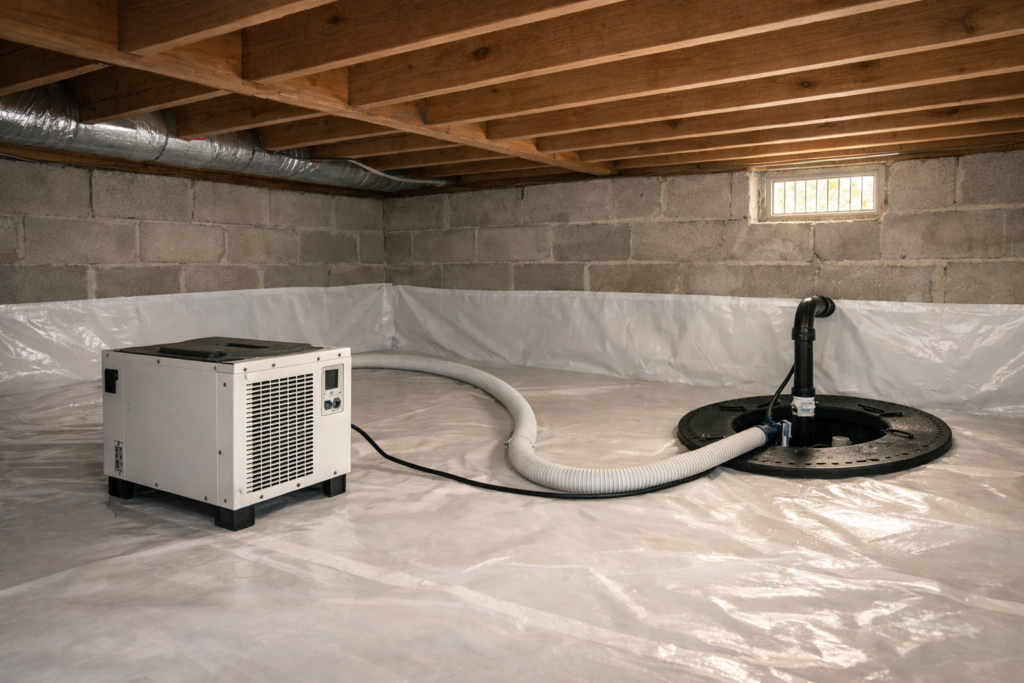
A crawl space dehumidifier is designed for a very different environment than a standard room unit. Crawl spaces are enclosed, often humid, and directly connected to your home’s structure. Choosing the right unit helps control moisture, protect floor framing, and reduce long-term mold risk.
This guide explains how to select the correct size, capacity, and drainage setup for your space.
Step 1: Measure Your Crawl Space Size
Start by calculating square footage.
Multiply the length by the width of the crawl space. If the layout is irregular, divide it into sections and add them together.
Common size ranges include:
-
Under 1,000 sq ft
-
1,000–1,500 sq ft
-
1,500–2,000 sq ft
-
Over 2,000 sq ft
Coverage rating is one of the most important selection factors. For a deeper breakdown, see What Size Dehumidifier Do I Need for a Crawl Space?
If your space is compact or segmented, you may also want to review Best Crawl Space Dehumidifier for Small Crawl Spaces.
Step 2: Understand Pint Capacity
Dehumidifiers are rated by how many pints of moisture they remove per day.
Crawl space units typically range from 70 to 120+ pints per day.
As a general guide:
-
Mild humidity → lower capacity
-
Consistently damp air → mid-range capacity
-
Heavy moisture or musty odor → higher capacity
If you’re unsure how capacity affects performance, read How Many Pints Should a Crawl Space Dehumidifier Be?
Step 3: Check Your Humidity Levels
Before selecting a unit, measure the humidity in your crawl space using a hygrometer.
Ideal humidity range:
45%–55% relative humidity
If levels regularly exceed 60%, you’ll need a properly sized crawl space-rated unit rather than a standard portable model.
If you’re concerned about over-drying the space, see Can a Crawl Space Be Too Dry?
Step 4: Choose the Right Drainage Method
Crawl space dehumidifiers are designed for continuous drainage.
There are two main types:
Gravity Drain
Water flows downward through a hose into:
-
A floor drain
-
A sump pit
-
An exterior outlet
This works well if your crawl space has a low discharge point.
Built-In Condensate Pump
A pump allows water to be moved upward or across longer distances.
If your space does not have a natural downhill drain path, a pump model is often necessary.
For more detail, see:
Step 5: Look for Crawl Space-Specific Features
Avoid standard residential room dehumidifiers.
Crawl space units should include:
-
Low-temperature operation capability
-
Corrosion-resistant internal components
-
Continuous drainage design
-
Auto-restart after power outage
-
External or built-in humidistat control
-
Compact horizontal layout
If winter temperatures drop in your area, review Best Low Temperature Crawl Space Dehumidifier.
Step 6: Consider Energy Efficiency
Many crawl space units operate for long periods.
Look for:
-
Energy Star certification
-
High moisture removal per watt
-
Adjustable humidity control
-
Efficient fan operation
If you’re concerned about long-term operating cost, see:
Step 7: Encapsulated vs Non-Encapsulated Crawl Spaces
If your crawl space is encapsulated (sealed with a vapor barrier on the floor and walls), you’ll need a unit suited for controlled environments.
Encapsulated spaces:
-
Hold humidity more consistently
-
Require steady, balanced moisture removal
-
Benefit from correctly matched capacity
If your space is sealed, review Best Dehumidifier for Encapsulated Crawl Space.
Step 8: Placement and Access
Plan installation carefully.
Allow for:
-
Proper airflow around intake and exhaust
-
Access for maintenance and filter cleaning
-
Stable, level placement
-
Secure hose routing
For more guidance, see Where Should You Place a Dehumidifier in a Crawl Space?
Quick Selection Checklist
Before purchasing, confirm:
-
Correct square footage coverage
-
Appropriate pint capacity
-
Drainage method matches your layout
-
Suitable for low temperatures
-
Energy efficient for long run times
-
Compatible with encapsulated space (if applicable)
For a complete product comparison overview, see Best Crawl Space Dehumidifier.
Final Thoughts
Choosing a crawl space dehumidifier is primarily about matching the unit’s capacity and drainage setup to your specific environment.
Measure the space accurately.
Check humidity levels.
Choose a crawl space-rated unit designed for continuous operation.
When properly sized and installed, a crawl space dehumidifier can quietly maintain stable moisture levels and help protect the structure of your home over the long term.