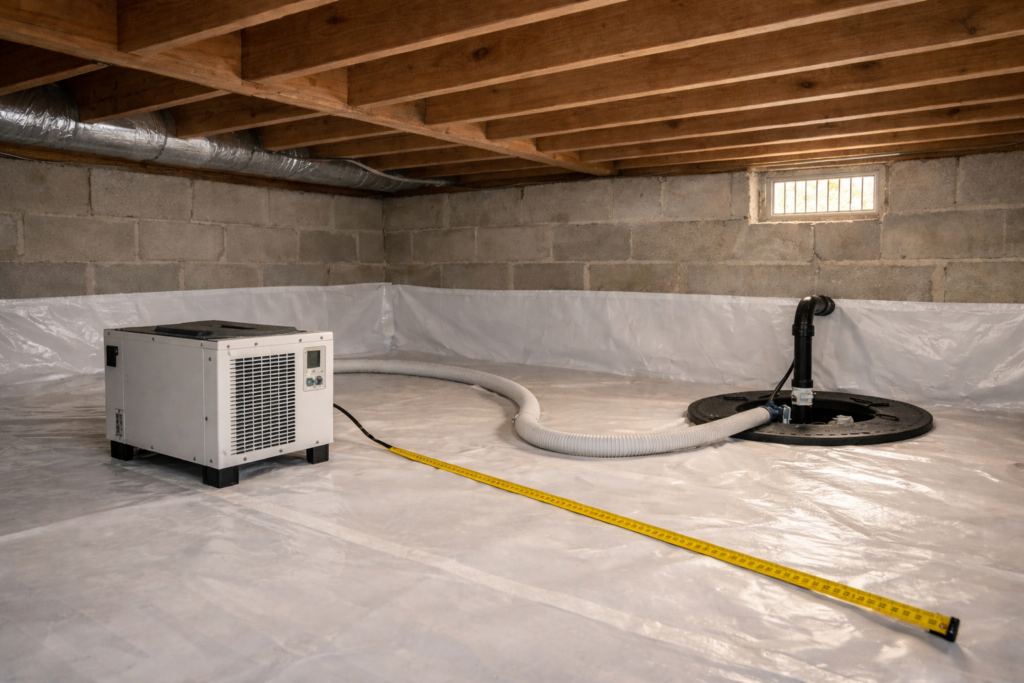
Choosing the correct size dehumidifier for a crawl space is one of the most important decisions you’ll make. An undersized unit will run constantly without lowering humidity. An oversized unit may short-cycle and operate inefficiently.
Sizing comes down to three main factors:
-
Square footage
-
Moisture level
-
Crawl space condition (sealed vs vented)
This guide walks through each step clearly.
Step 1: Measure Your Crawl Space
Start with total square footage.
Multiply the length by the width of the crawl space. If it’s irregular, divide it into sections and add them together.
Common ranges:
-
Up to 1,000 sq ft
-
1,000–1,500 sq ft
-
1,500–2,000 sq ft
-
2,000+ sq ft
If you’re still deciding which type of unit to buy, start with How to Choose a Crawl Space Dehumidifier for a full overview.
Step 2: Understand Pint Capacity Ratings
Crawl space dehumidifiers are rated in pints per day (PPD). This measures how much moisture the unit can remove in 24 hours under standard conditions.
Typical crawl space sizes:
-
70–80 pints → small to moderate spaces
-
90–110 pints → mid-size spaces
-
120+ pints → large or high-moisture areas
For a detailed explanation of moisture removal ratings, see How Many Pints Should a Crawl Space Dehumidifier Be?
Step 3: Factor in Moisture Conditions
Square footage alone is not enough.
You also need to consider how damp the crawl space is.
Light moisture:
-
Slight musty odor
-
Humidity around 55–60%
Moderate moisture:
-
Consistent humidity above 60%
-
Occasional condensation
Heavy moisture:
-
Visible dampness
-
Persistent musty smell
-
Signs of mold growth
Heavier moisture requires higher pint capacity, even in smaller spaces.
If humidity regularly exceeds safe levels, review Can a Crawl Space Be Too Dry? to understand proper target ranges.
Step 4: Sealed vs Vented Crawl Spaces
Encapsulated (sealed) crawl spaces are easier to control because outside air is limited.
Vented crawl spaces often:
-
Experience seasonal humidity swings
-
Require larger capacity
-
Run longer during humid months
If your crawl space is encapsulated, you may want to compare options in Best Dehumidifier for Encapsulated Crawl Space.
Step 5: Quick Sizing Guide
This is a general guideline for average conditions:
Up to 1,000 sq ft
→ 70–90 pint unit
1,000–1,500 sq ft
→ 90–110 pint unit
1,500–2,000 sq ft
→ 100–120+ pint unit
Over 2,000 sq ft
→ 120+ pint unit or multiple units
If your space is very small, see Best Crawl Space Dehumidifier for Small Crawl Spaces.
If it’s larger than average, review options in Best Crawl Space Dehumidifier for 2,000 sq ft
Step 6: Avoid Common Sizing Mistakes
Do not:
-
Choose based only on price
-
Use a standard room dehumidifier
-
Ignore drainage setup
-
Undersize to save electricity
A properly sized unit runs efficiently and maintains steady humidity rather than cycling constantly.
For overall recommendations across sizes, see Best Crawl Space Dehumidifier.
Step 7: Confirm Drainage Compatibility
Capacity is only part of sizing.
You must also match the drainage method to your crawl space layout.
If there is no gravity drain available, you may need a pump model. See:
Ideal Humidity Target
Once installed, aim to maintain:
45%–55% relative humidity
If you’re unsure about runtime expectations after sizing, review How Long Should a Crawl Space Dehumidifier Run?
Final Thoughts
The right size crawl space dehumidifier depends on:
-
Accurate square footage
-
Moisture severity
-
Crawl space design
-
Drainage layout
When in doubt, it’s generally better to choose slightly higher capacity rather than undersizing.
Proper sizing ensures stable humidity control, reduced mold risk, and long-term structural protection.