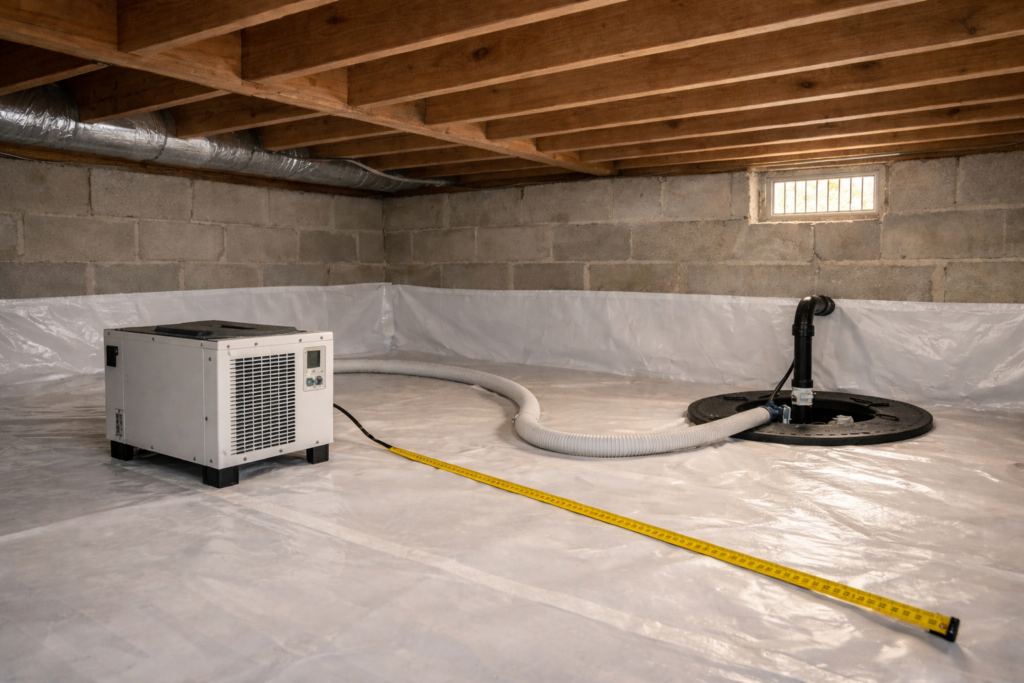
The right size dehumidifier for a crawl space depends on the square footage, moisture level, drainage setup, and whether the crawl space is sealed or vented. A small sealed crawl space may only need a moderate crawlspace-rated unit, while a damp, vented, or larger crawl space may need more capacity than the square footage alone suggests.
The safest way to size a crawl space dehumidifier is to start with the floor area, then adjust for moisture severity. An undersized unit may run constantly and still fail to control humidity. An oversized unit may cost more than necessary, especially if the crawl space is sealed and only mildly damp.
If the crawl space is large, wet, vented, or repeatedly difficult to control, a higher-capacity unit may be needed. Our best commercial crawl space dehumidifier guide compares heavier-duty options for more demanding moisture problems.
Quick Answer: Crawl Space Dehumidifier Size Guide
This table is only a starting point. A sealed 1,500 sq ft crawl space with mild humidity may need less capacity than a smaller vented crawl space with constant outside moisture entering.
After estimating the size and moisture level of the space, it helps to compare actual crawlspace-rated product options. Our best crawl space dehumidifier guide covers different choices for small crawl spaces, larger spaces, pump drainage, encapsulated areas, and heavier moisture problems.
Step 1: Measure the Crawl Space
Start by estimating the total square footage of the crawl space. Multiply the length by the width. If the space has an irregular shape, divide it into smaller rectangles, calculate each section, and add them together.
Common crawl space size ranges include:
- Up to 1,000 sq ft: Small crawl spaces, compact foundations, and tight access areas.
- 1,000–1,500 sq ft: Medium crawl spaces where capacity and drainage both start to matter more.
- 1,500–2,000 sq ft: Medium-to-large crawl spaces where undersizing becomes a bigger risk.
- Over 2,000 sq ft: Larger crawl spaces that may need stronger capacity, better airflow planning, or a heavier-duty unit.
If your crawl space is very small or difficult to access, see Best Crawl Space Dehumidifier for Small Crawl Spaces.
If your crawl space is around 1,500 sq ft, the right choice depends on more than square footage. A sealed space may need a different setup than a damp or vented one, so compare the options in our best crawl space dehumidifier for 1,500 sq ft guide before choosing by pint rating alone.
If your crawl space is closer to 2,000 sq ft, sizing becomes more important because moisture load, sealing, and drainage can vary a lot from one home to another. For larger spaces, compare the options in our best crawl space dehumidifier for 2,000 sq ft guide before choosing by pint rating alone.
Step 2: Understand Pint Capacity Ratings
Crawl space dehumidifiers are often described by pint capacity. This rating refers to how much moisture the unit can remove from the air over a set period under test conditions.
The important thing to remember is that pint capacity is not the same as square footage. A 70-pint class unit may be enough for some crawl spaces, but not others. The actual result depends on humidity level, sealing, temperature, drainage, and how much moisture keeps entering the space.
As a general rule:
- Lower-capacity crawlspace units: Better for smaller or mildly damp crawl spaces.
- 70-pint class units: Often a practical starting point for many medium crawl spaces.
- Higher-capacity units: Better for large, wet, vented, or harder-to-control crawl spaces.
- Commercial-style units: Better reserved for severe moisture, larger spaces, or demanding conditions.
For a detailed explanation of moisture removal ratings, see How Many Pints Should a Crawl Space Dehumidifier Be?.
An undersized unit may run constantly and still fail to control humidity. If you are unsure whether runtime is normal, read our guide on whether crawl space dehumidifiers run all the time after comparing size and moisture load.
Step 3: Match Capacity to Moisture Level
Square footage alone is not enough. Two crawl spaces with the same floor area can need very different dehumidifiers if one is sealed and mildly humid while the other is vented, wet, or musty.
Use the moisture level to adjust your sizing decision.
- Light moisture: Slight musty odor, mild seasonal humidity, no visible dampness, and humidity only slightly above the ideal range.
- Moderate moisture: Regular humidity above the target range, occasional condensation, damp air, or seasonal moisture that returns often.
- Heavy moisture: Visible dampness, persistent musty smell, wet ground, condensation, mold concerns, or humidity that stays high even after the unit runs.
A small crawl space with heavy moisture may need more dehumidifier than a larger crawl space with mild moisture. That is why buying only by square footage can lead to the wrong choice.
If the crawl space is still damp after a dehumidifier has been running, the issue may not be size alone. It may also involve drainage, placement, air leaks, ground moisture, or bulk water. See Why Is My Crawl Space Still Damp After Using a Dehumidifier?.
Step 4: Consider Sealed vs Vented Crawl Spaces
A sealed or encapsulated crawl space is usually easier to dehumidify than a vented crawl space. When vents, exposed soil moisture, and outside air leaks are reduced, the dehumidifier has a more stable environment to manage.
A vented crawl space can be harder to control because humid outdoor air may keep entering. This can make the unit run longer and may require more capacity than the same square footage in a sealed crawl space.
This is why a 1,500 sq ft sealed crawl space may not need the same dehumidifier as a 1,500 sq ft vented crawl space with damp air entering throughout the humid season.
If your crawl space is sealed or encapsulated, compare options in Best Dehumidifier for Encapsulated Crawl Space. You may also want to read Do You Need a Dehumidifier in a Sealed Crawl Space?.
Step 5: Use a Practical Sizing Decision
The best crawl space dehumidifier size is not always the largest unit you can afford. The better choice is the smallest suitable crawlspace-rated unit that can maintain the target humidity without running constantly.
For a small, sealed, mildly damp crawl space, a compact or moderate crawlspace-rated unit may be enough. For a medium crawl space with normal moisture, a 70-pint class option may be a practical starting point. For a larger, vented, wet, or hard-to-control crawl space, a stronger unit may be needed.
If the crawl space is large, damp, or has a layout that makes airflow difficult, compare product options carefully before choosing. A unit that is too small may save money upfront but cost more in runtime and still leave the space damp.
For overall recommendations across sizes and moisture levels, see Best Crawl Space Dehumidifier.
Step 6: Confirm Drainage Compatibility
Capacity is only part of sizing. The dehumidifier also needs a drainage setup that works in the crawl space layout.
If the unit can drain continuously downhill to a safe location, a gravity drain may be enough. If the water needs to move upward, across the crawl space, or to a discharge point that is not lower than the unit, a pump-equipped dehumidifier may be easier to install.
Drainage becomes more important as crawl space size increases because the best location for airflow may not be the easiest location for the drain hose. A good installation balances capacity, placement, drainage, and service access.
For drainage guidance, see Do Crawl Space Dehumidifiers Need a Drain Line? and Gravity Drain vs Pump Drain for Crawl Space Dehumidifiers.
If gravity drainage is not practical, compare options in Best Crawl Space Dehumidifier with Pump.
Step 7: Check Placement and Airflow
A dehumidifier that is technically large enough can still struggle if it is poorly placed. Crawl spaces often have piers, walls, insulation, stored items, ductwork, or separated sections that affect airflow.
The unit should be placed where it can pull in damp air, discharge dry air, drain properly, and remain accessible for maintenance. If the crawl space has separate zones, one unit may not control every area evenly unless placement is planned carefully.
Bad placement can make the dehumidifier run longer because it dries the area near the unit but does not move enough air through the rest of the crawl space.
For placement guidance, see Where Should You Place a Dehumidifier in a Crawl Space?.
Step 8: Avoid Common Sizing Mistakes
The most common mistake is choosing a dehumidifier only by price, pint rating, or square footage. Crawl spaces are harder to size because moisture conditions vary so much from one home to another.
Avoid these mistakes:
- Using a regular room dehumidifier permanently: Crawl spaces usually need continuous drainage, low-clearance placement, and better long-term reliability.
- Ignoring moisture sources: A dehumidifier should not be expected to solve standing water, leaks, or drainage failures by itself.
- Undersizing to save electricity: A smaller unit may run constantly and still fail to maintain humidity.
- Oversizing without reason: A heavy-duty unit may be unnecessary in a sealed, mildly damp crawl space.
- Ignoring drainage: The best-sized unit can still be a poor choice if the drain route does not work.
- Forgetting maintenance access: The filter, hose, controls, and pump area still need to be reached after installation.
If you are still deciding which type of unit to buy, start with How to Choose a Crawl Space Dehumidifier for a full overview.
Ideal Humidity Target
Once installed, the goal is to keep the crawl space within a stable humidity range rather than making the space extremely dry. Many homeowners aim for roughly 45%–55% relative humidity, but the right setting can depend on the crawl space conditions and the dehumidifier controls.
If the humidity setting is too low, the dehumidifier may run longer than needed. If the setting is too high, the crawl space may still feel damp or musty.
For more detail, see Ideal Humidity Level for a Crawl Space and Can a Crawl Space Be Too Dry?.
If you are unsure about runtime expectations after sizing, review How Long Should a Crawl Space Dehumidifier Run?.
Frequently Asked Questions
What size dehumidifier do I need for a crawl space?
The right size depends on the crawl space square footage, moisture level, sealing, drainage, and airflow. A small sealed crawl space may need a moderate unit, while a vented or wet crawl space may need more capacity even if the floor area is smaller.
Is a 70-pint dehumidifier enough for a crawl space?
A 70-pint class crawl space dehumidifier may be enough for many small to medium crawl spaces with normal moisture. It may not be enough for a large, wet, vented, or repeatedly damp crawl space.
Can a crawl space dehumidifier be too big?
Yes, a unit can be larger than necessary if the crawl space is sealed, mildly humid, and easy to control. Oversizing may cost more than needed, so it is better to match capacity to the actual moisture load.
What happens if the dehumidifier is too small?
An undersized unit may run constantly, struggle to reach the target humidity, and fail to control musty odors or damp conditions. It may also use more energy over time because it works too hard.
Should I size by square footage or pints?
Use both, but do not rely on either one alone. Start with square footage, then adjust for moisture severity, crawl space sealing, drainage, and airflow.
Final Thoughts
The right size crawl space dehumidifier depends on square footage, moisture severity, crawl space design, drainage layout, and whether the space is sealed or vented.
When in doubt, avoid choosing the smallest unit just to save money. A slightly stronger crawlspace-rated unit may be better than an undersized one if the crawl space is damp, vented, musty, or difficult to dry.
At the same time, do not automatically choose the largest unit if the crawl space is sealed and only mildly humid. The best choice is the unit that can maintain stable humidity, drain reliably, fit the space, and be serviced after installation.